Pop Mart’s desserts and Wang Ning’s idea of celebration
Pop Mart’s first dessert shop shows how the company is making celebration an everyday experience while preserving the appeal of its character IP.
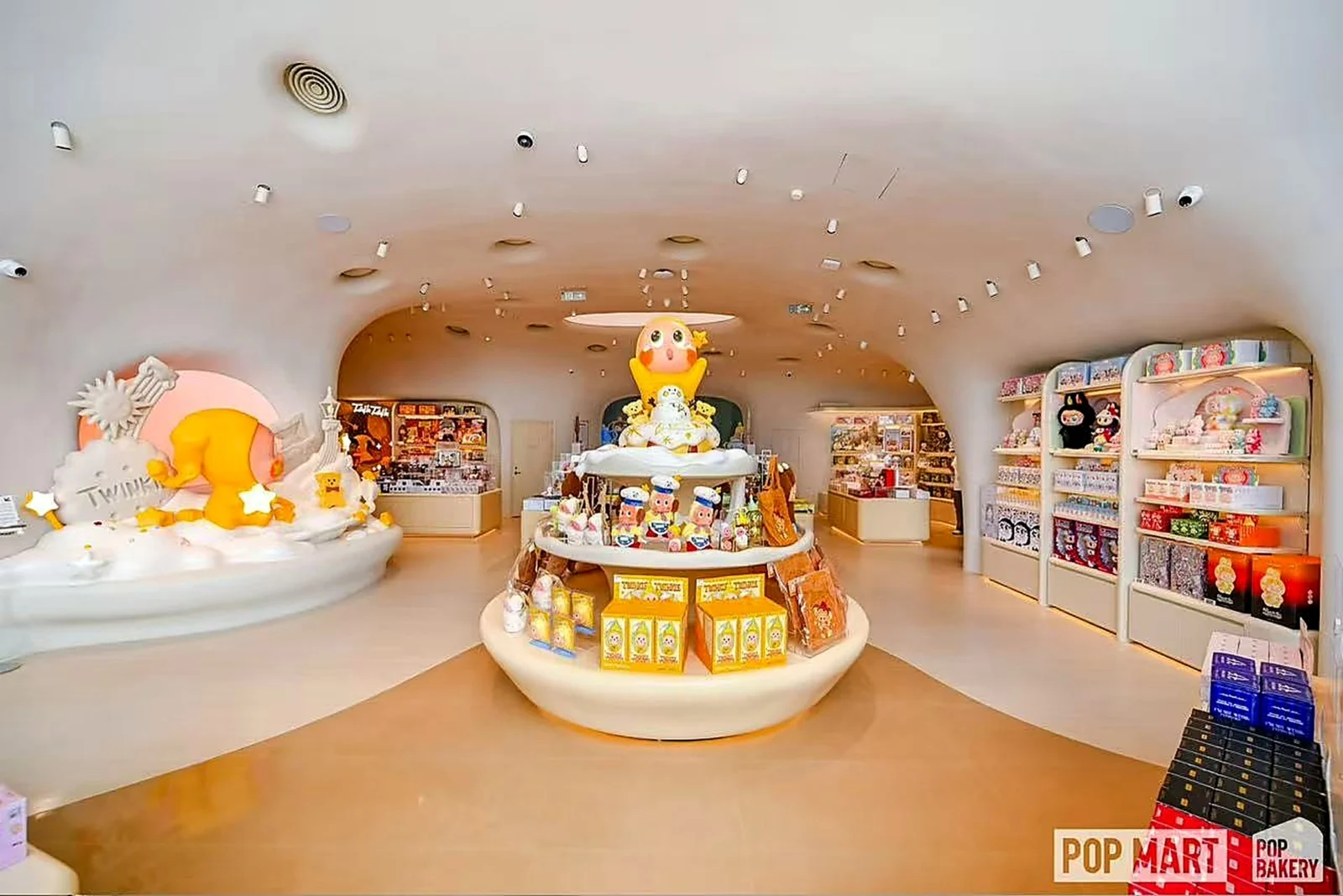
On June 19, Pop Mart’s dessert brand POP BAKERY opened its first standalone store at the seaside resort of Aranya in Qinhuangdao. Half the store is devoted to blind boxes, and the other half is a dine-in dessert area. On one side is the familiar crowd unboxing toys. On the other, customers sit down for limited-edition cakes and specialty drinks.
—
Inside POP BAKERY’s first store in Aranya
Pop Mart has tried gaming, is making home appliances, and has turned jewelry into a standalone brand, POPOP. Why does Brandstar see desserts as a more natural extension of its core business than another move into an unrelated category? What makes desserts different?
01. The “no USB drive” rule and the dilemma it created
The answer starts with a long-standing rule set by Pop Mart founder Wang Ning.
He once posed a question that has been widely repeated: “If you pulled off a MOLLY doll’s head and found a USB drive, would you still buy so many?” The point was simple. Designer toys derive their value from the feelings they evoke. Give a toy a practical use and it goes from an object people love to something they use, weakening the emotional attachment.
Wang has long advocated restraint with merchandise. Strong IP can wait before it gets turned into a range of basic products. Printing characters on mugs and notebooks is the designer toy industry’s most common way to monetize IP, with low marginal costs and quick returns. Pop Mart has largely stayed away from it.
Brandstar sees a genuinely scarce resource behind that restraint. Pop Mart has never been short on money, production capacity, or distribution. What is scarce is the strength of consumers’ attachment to its IP. The premium they are willing to pay for MOLLY or LABUBU is easily eroded, a little at a time, with each printed product, collaboration, and merchandise release. That attachment matters more to Pop Mart than any individual character. Its pricing power depends on it.
The rule also creates a dilemma. The stronger the IP, the greater the temptation to monetize it. The less Pop Mart relies on a broad range of merchandise, the more growth depends on a handful of properties. Pop Mart’s 2025 revenue grew 184.7% to RMB 37.12 billion. THE MONSTERS, the series that includes LABUBU, alone contributed RMB 14.16 billion, nearly 40% of the total. In Q1 2026, growth slowed to between 75% and 80%. Pop Mart has to exercise restraint and resist growing by putting characters on mugs, while keeping the group from depending on one or two properties. It has to find a way to keep growing, preserve consumers’ attachment to its IP, and reduce its exposure to any single property. Desserts are one answer.
02. The theme park changed what was possible
Pop Mart developed its dessert business step by step.
In August 2024, the first MOLLY Dessert House opened at Pop Mart’s theme park in Beijing’s Chaoyang Park, with a focus on park exclusives. In 2025, dessert pop-ups reached more than 20 cities, including Beijing, Shanghai, and Chengdu. That December, POP BAKERY opened a pop-up at Beijing Capital International Airport as a standalone brand. Its first standalone brick-and-mortar store followed in Aranya in June 2026. Pop Mart tested the concept in the park, used pop-ups to validate demand in more cities, and then built it into a standalone brand. Each step built on what had worked in the previous one.
The theme park was the turning point.
—
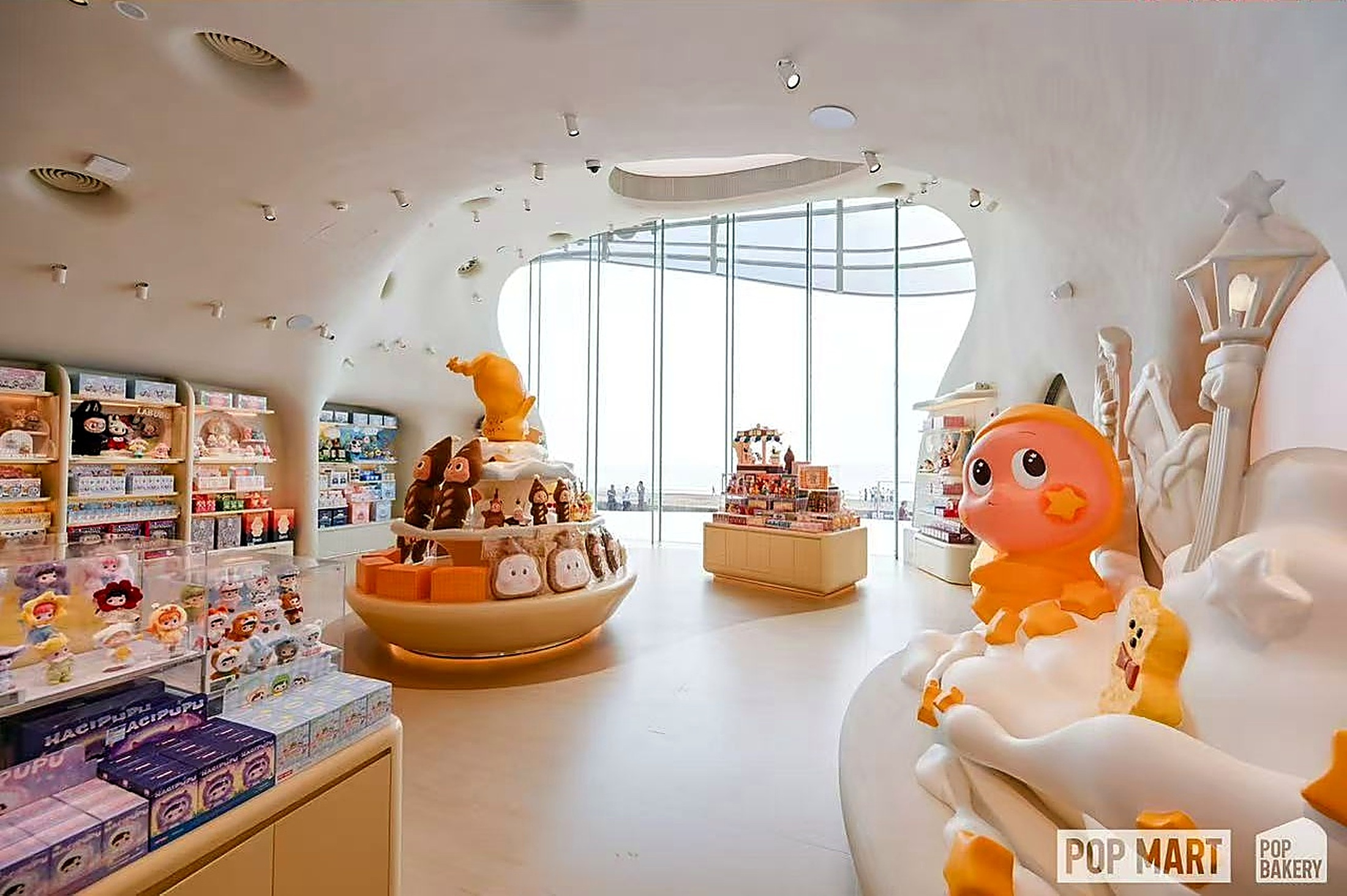
The POP BAKERY storefront and dine-in dessert area
When Pop Mart had only blind boxes and merchandise, its IP was something you bought, took home, and put on your desk. The theme park and stores gave Pop Mart physical formats it could replicate at scale. Consumers could now step into a world built around the characters, with room to browse, sit, take photos, and shop. That deepens their attachment to the IP. Putting a character on a mug wears away at its appeal, while building a space people can step into adds to it.
Desserts give customers the most frequent reason to enter that world. People eat out far more often than they buy blind boxes, so the characters they might occasionally unbox and put on display can become part of everyday life. Traditional merchandise licensing can make money, but Pop Mart has set it aside because it does little to build a world people can enter. The more products the characters are printed on, the further the IP gets from that kind of experience.
03. Desserts and the feeling of celebration
Something else Wang Ning has said helps explain the choice of desserts. He wants people to “not only enjoy your life, but also celebrate your life.” What customers are paying for, beyond the plastic, is that feeling of celebration.
Wang has described what that feeling means in practice. He uses four words for the experiences he wants Pop Mart to offer, moving from quiet moments alone to lively gatherings: peace, love, enjoy, and celebrate. He pairs each with a seaside scene. “Peace” is the calm of looking out at the ocean or taking in a forest. “Love” is the pleasure of sitting in a seaside café. “Enjoy” is having dinner at a bar by the water. “Celebrate” is inviting all your friends to your birthday party. Wang wants Pop Mart to move beyond “enjoy” and closer to “celebrate,” taking a cue from Disneyland, where the whole place feels like a celebration.
Desserts already have a place in celebrations. You cut a cake on a birthday, buy sweets for a holiday, or have a drink on vacation. Afternoon tea is itself a way to set aside time for yourself and make it feel special. Eating is an everyday activity that can also be a ritual, give people a reason to linger, and offer something to photograph. Its link to celebration comes naturally. Aranya, both a cultural destination and a seaside resort, suits that feeling.
Desserts also meet Brandstar’s three criteria for extending IP into a new category or line of business. Whether the extension adds to the IP’s appeal depends on whether it gives people a physical experience, shares a location with the core business, and preserves consumers’ attachment to the characters. Desserts meet all three criteria. The dine-in area gives people somewhere to sit, linger, and take photos. The characters are part of a place customers can step into, beyond the objects they can take home. The dessert counter sits next to the blind-box section, so someone stopping in for dessert can pick up a blind box, and someone opening a box can sit down for cake. Each side draws customers to the other. Finally, limited-edition desserts served on-site bring a sense of ritual that reinforces the feeling of celebration. Printing a character on a mug would dilute it.
POPOP, another business within the group that became a standalone brand and opened physical stores, also appears at first to offer that kind of physical experience. But most POPOP stores are standalone jewelry shops in malls, separate from where customers buy blind boxes. Jewelry purchases are infrequent and carry a high average transaction value, making them more of a considered purchase than a recurring part of daily life. Desserts are distinctive because people buy them often, can find them alongside blind boxes, and already associate them with celebrations.
The group’s Lifestyle Home appliance line is further removed. Breakfast makers and electric kettles are functional products. They offer no immersive setting or sense of celebration and come close to the USB drive Wang warned against. Pop Mart also tried its hand at gaming before scaling back. Games have neither a physical setting nor a shared retail location with blind boxes, putting them further from the world Pop Mart has built around its characters.
Desserts are one of the few categories that can offer a physical experience, share a location with the core business, and preserve the appeal of the IP.
Final thoughts
POP BAKERY matters to Pop Mart beyond how much cake it sells today. It has validated a criterion for expansion: protect the emotional attachment that makes the IP valuable, and expand only into settings people can step into without weakening that attachment. It is the “no USB drive” rule adapted to a business that now includes a theme park and physical stores.
Meeting that criterion is only a start. Whether the cakes taste good, offer value for money, and bring customers back a second and third time will show up in the repeat purchase rate. That metric will tell Pop Mart more about the business than the initial buzz.
Can Pop Mart turn a one-off visit for a photo into an everyday celebration that people keep coming back for?
IP · POP BAKERY · Brand Extensions · Pop Mart
More stories →