How everyday content builds a lasting brand story
As individual posts get lighter and brands seek deeper customer relationships, the challenge is to give each piece a clear purpose and connect it to a story that builds over time.
Over the past year, Brandstar published its Small Content Trends Report, followed by its Branding Trends Report. Read together, the two reports approach the same question from different angles. As media fragmentation becomes the norm and a single major ad struggles to build lasting awareness, how do brands stay in consumers’ minds?
One side is about keeping it small. Brandstar defines small content as lightweight, human, highly interactive and easy to share, a way for brands to start conversations with their audiences. Length alone is beside the point, and simply chopping up a larger piece misses the purpose. Each piece has one clear job. It addresses a specific situation, brings out an aspect of the brand’s personality and contributes to the larger story.
The other side is about going deep. We see the past year’s business shift as a move from competing for growth through scale to competing in a mature market by creating more value. For content teams, the real test is whether a series of communications can turn a fleeting moment of attention into a lasting relationship.
“Small” and “deep” may seem like opposites, but they describe different things. Small refers to the specific angle each piece takes. Deep refers to the lasting relationship that builds as those pieces accumulate. Each piece can tell just one part of the brand’s story. When everyday content consistently helps people understand the brand from a recognizable point of view, a clear impression takes shape over time. Content usually feels fragmented because the pieces have little to do with one another, regardless of length.
Across many of the brand teams we’ve worked with, the most common issue is a disconnect between long-term storytelling and day-to-day operations. Some have a narrative they struggle to put into practice. Their positioning, philosophy and story stay in brand manuals, pitch decks and a handful of major projects, leaving teams unsure how to turn them into everyday topics, recurring features and editorial criteria. Others publish regularly without a clear direction. They keep posting, follow trends and try new formats. Individual pieces may perform well, but each touchpoint has its own voice and priorities, so audiences see plenty of content and still struggle to form a clear, lasting impression. What’s missing is a way to turn brand direction into daily decisions and use feedback to refine that direction.
Break the brand story into smaller pieces that fit together
For brands still developing their narrative, small content can also be a tool for exploration. They can start with what we call the brand’s “smallest unit of consensus,” a single point of identification that the brand already shares with its core audience and that goes beyond what the product does. It can be the seed of a story, as long as it’s authentic, specific and capable of generating more content.
Heytea’s recent work with small content offers a concrete example. From mid-2025, handwritten lettering, simple doodles, inspiration cards and copy on construction hoardings began appearing regularly. The brand also turned WeChat Moments posts from the tea garden of Longjing grower Yan Yu and a drawing by the daughter of a grape grower in Yunnan into stickers and small keepsakes. These pieces may have emerged without a fully scripted narrative. Through repeated experimentation, Heytea landed on a voice that felt more authentic and approachable and gave people more ways to participate. Established brands can draw small pieces from an existing story, while brands still finding their voice can use those pieces to work back toward a narrative. In both cases, each piece tests the same direction, even when the full answer is still taking shape.
What gives small content its pull is the story behind it
Brandstar defines a brand narrative as the answer a brand gives over time to three questions. Who am I? What do I believe? How do I act? Its scope goes well beyond a slogan or an annual brand film. The answer shows up in products, content, physical spaces and relationships with consumers. It also guides everyday creative decisions.
Brandstar has observed a shift from isolated marketing efforts to an ongoing narrative grounded in a central vision. Publishing regularly is only part of building affinity. What makes content stick is a consistent, recognizable set of values linking one piece to the next.
Without a basic direction or a way to review the work, each piece becomes an isolated fragment. Today’s trending meme and yesterday’s product shot do little for each other. The volume grows, but audiences still can’t piece together a coherent picture of the brand. As the direction comes into focus, each small piece can add a detail to the same story.
Adidas is one example. After launching its global “You Got This” brand platform in 2024, it continued to shift the emphasis from winning and losing to how everyday people experience sports. Running to Paris follows a group of recreational runners who crossed 12 countries and covered 10,211 kilometers in 112 days to reach France. The 2025 Women’s Day ad There’s Always a Voice That Makes You Believe puts Wu Yanni’s mother, Xiong Yan, and others who support athletes from the sidelines front and center. Each piece brings “You Got This” to life from a different angle through real people, their relationships and the ways they show up for one another.
GIADA’s podcast Tales of Flowers in the Rocks took a different path. After experimenting across several seasons, the show brought on Lu Yu as a regular host in season three and focused on issues affecting women, a direction it has maintained season after season. The host, range of topics and conversational tone took shape through ongoing production.
A narrative helps content teams decide which ideas are worth returning to while leaving room for individual creative decisions. As the direction becomes clearer, each lightweight piece can reinforce the same impression of the brand.
Four questions for building a brand narrative
A brand narrative can take shape over time, but day-to-day creative work needs a consistent set of criteria. The cases we studied suggest four questions brands can start with.
Who am I? Find a consistent way to explain what the brand stands for
One of Brandstar’s central observations is the need to get back to clarity and away from complexity. Uniqlo launched its New Life City Tour series in 2024, taking it to Shanghai, Wuhan, Beijing, Shenyang, Guangzhou and Chengdu in succession. The cities and people change, but the content keeps asking the same question. How can clothing serve the way people live here and now? Clarity comes from a consistent way of explaining the brand, with enough substance to hold up across different stories.
The test is whether the team can use the same principles to make choices across different topics. A common benchmarking pitfall is that teams can say who they want to emulate but struggle to explain why those choices fit their own brand. They borrow the visuals from one brand, the tone from another and the recurring features from a third. The look changes quickly, but the brand’s own history, capabilities and customer relationships never make it into the content. Benchmarking offers a point of reference. The brand still needs to find its bearings in its own experience. If every piece has to reinvent the brand, publishing more often only adds to the confusion.
What do I believe? Show it through decisions
Another common pattern starts with teams deciding what to do based on trends, sales opportunities or competitor activity. As launch approaches, the content team is asked to supply a theme and a story. The resulting content can explain what’s on sale this time but struggles to give a consistent answer about why the brand makes those choices. When content is routinely brought in at the end, even a steady stream of small pieces can do little more than give each launch a talking point. The product decisions never add up to a story.
Competitors can easily copy vague slogans about values. Publicly committing to the same choices and accepting the same costs is harder. In Work in Progress, Patagonia disclosed that it had missed several sustainability targets, including its goal of cutting carbon emissions by 10% each year. The company made those shortfalls part of its long-term story. A brand’s stance shows up in what it chooses to do, what it is willing to disclose and what it accepts as a consequence.
Whose story do I tell? Decide whose lives to draw from
The people at the center of a brand story can come from well beyond its roster of spokespeople. Heytea puts tea growers, fruit growers and their families up front, making the places where its ingredients are grown and the details of everyday life there part of the brand’s identity. McDonald’s draws “fan moments” from familiar experiences its most loyal customers have time and again. Arguments over pickles, cheese sticking to the wrapper and friends sneaking fries are all part of a language the brand shares with its fans.
Choosing who takes center stage determines whose lives the content team will keep drawing from. Customers and others with real ties to the brand supply evidence from beyond the brand’s own account. Their value goes beyond the volume of material they can provide.
What do I keep coming back to? Find a theme with room to grow
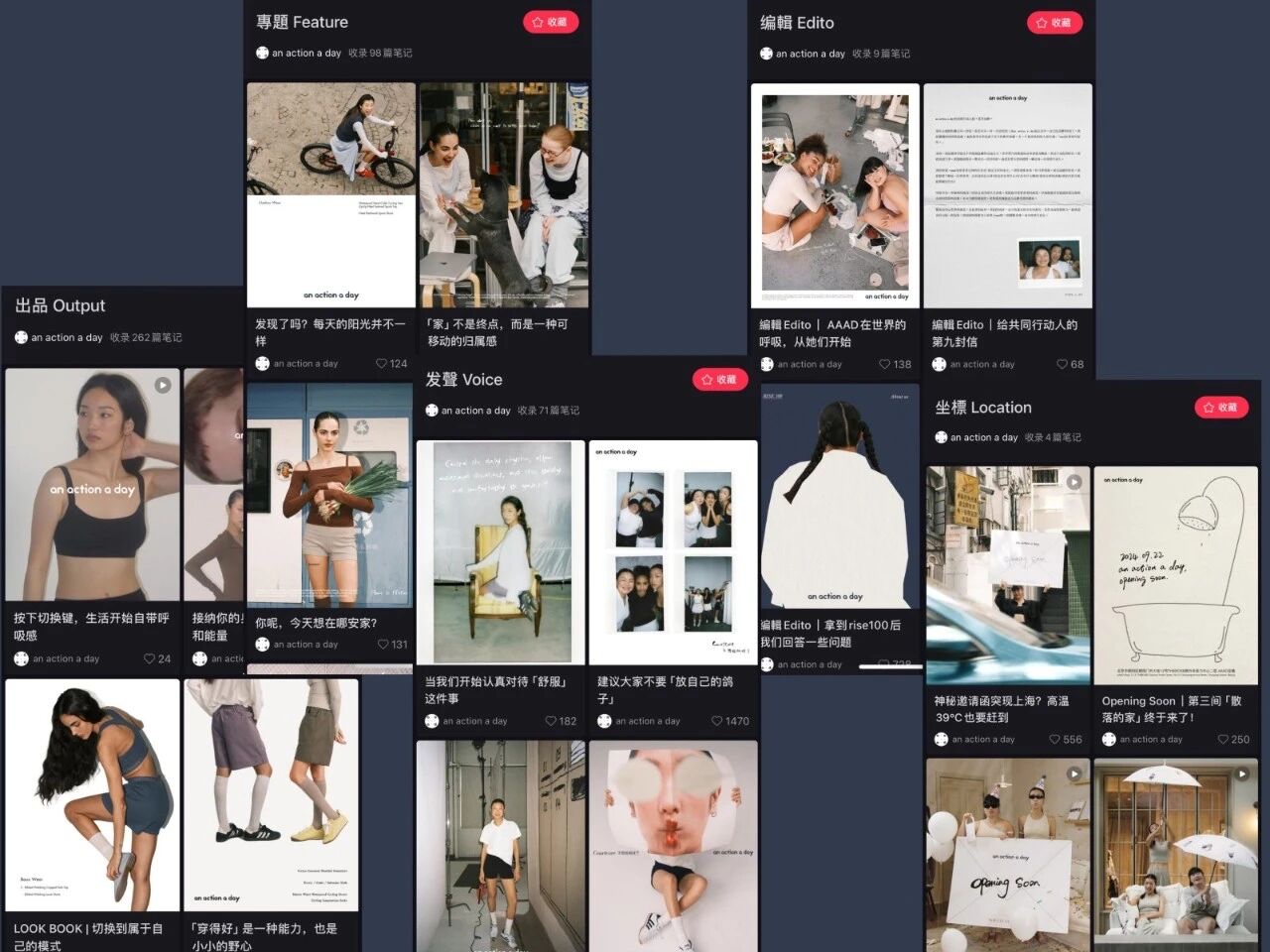
An overarching theme gives a brand a consistent way to interpret different subjects and can generate new topics over time. MUJI has long explored the idea of nature, from “The Reassurance of Nature” and “Natural Living” to an aroma crystal diffuser gift set developed with the Shanghai Natural History Museum. The same idea comes through in materials, products and local everyday settings. An action a day builds its Editorial, Features and Productions sections around “Taking Action Together” and “Natural Scale.” From letters to its audience to everyday topics such as “A Weekend You Can Waste,” the brand maintains a consistent perspective on daily life.
—
an action a day organizes its content into sections including Editorial, Features and Productions
A good overarching theme is rooted in the brand’s DNA and cultural context, feels fresh when revisited at different times and can work at different scales, from a full year of content to a single everyday post. Channels and people can change while the brand’s point of view stays consistent.
How to build a system for small content
Once the direction is set, the next question is how to put it to work. The Small Content Trends Report notes that more brands seeking relief from the pressure to drive traffic are starting to treat small content as a systematic effort. The report emphasizes “user-centered content agility,” the ability to keep producing specific pieces that convey the brand’s personality in different situations and influence consumers at different points in their decision journey. The approach goes beyond breaking a campaign into smaller parts. It provides an ongoing way to produce content, gather feedback and adjust course. Drawing on Brandstar’s research and case studies, we break it down into five practices.
Many brands already have a plan. The hard part is making it part of the daily work: which topic to choose today, who decides and what criteria to use when reviewing it. If brand work starts only when a major project comes up, teams often scramble to pull people together before a deadline. After launch, they tend to save the final assets alone, leaving no record of why they chose the topics, how they made trade-offs or what they learned in the review. The next project starts from scratch. Small content offers a lighter approach. Use topic briefs, rules for recurring features, touchpoint checklists and review templates to solve common problems, then build those decisions into the daily workflow. The test is whether the team can apply those methods on its own next time.
Cadence gives major moments and everyday content a place
The first step is to give content a rhythm. Major moments in the annual narrative are like feasts that establish the theme and set the tone. Everyday small pieces are like snacks that keep the brand present and the interest alive. Both come from the same menu. Apple had run its annual Shot on iPhone Lunar New Year campaign for nine years by 2026. The lead film anchors the moment, while pet creators’ vlogs, short filming tutorials and influencer content bring the same theme to lighter touchpoints. To Summer ran “Freedom and Imagination” each March for three consecutive years, from 2024 to 2026. Its formats and topics changed from a woman writer’s study and Nosepaper to “A Spring Gathering by the Shore,” while the timing stayed fixed. Major moments give everyday content a purpose, and everyday content builds attention for those moments.
Recurring features give small content a home
A collection of one-off ideas is hard to sustain, and content reviews can turn into a vote on matters of taste. One person wants a more premium feel, another wants something younger, and someone else looks only at the latest performance numbers. Each view may make sense on its own, but the team has no common yardstick. Recurring features give small content a lasting home and turn an abstract narrative into practical boundaries around what’s worth revisiting and what should hold steady when a trend comes along. The team can build on what it has already done, and audiences learn what to expect from the brand.
Nanshizhao launched Nanshizhao Lab on Xiaohongshu, using a lab-notebook format to answer everyday kitchen questions, from how to make fluffy, tender scrambled eggs to how to heat milk without a skin forming. Each question comes from daily life, and together they reflect the brand’s grounding in food science. A recurring feature can turn what the brand knows into an expanding set of questions to explore, with a consistent name and format to hold it together.
Share some of the storytelling with users
Small content differs from major advertising in who gets to tell the story. It gives people with real ties to the brand a role in the telling, from consumers to people in the supply chain, such as tea producers and fruit growers. The brand’s job is to find what they have in common, give them room to speak in their own voices and bring those perspectives into the long-term narrative.
HEYTEA turned tea practitioner Auntie Yanyu’s WeChat Moments posts into little inspiration cards. The puppy in the tea garden, the soil and weather, and how it feels to wait for the tea leaves to grow all come from her daily observations. By preserving her way of looking at everyday life, the brand gives readers a tangible sense of life where the tea is grown, beyond the abstract promise of “quality ingredients.”




—
Everyday life in the tea garden through the lens of tea practitioner Auntie Yanyu
Giving users a greater role draws on a language the brand and its fans have shared for years. McDonald’s “Fan Truth” principle for social media starts with situations its most loyal fans experience again and again. Content such as the “McNugget Hero” and “all-day” hash browns grows out of memories and expressions the brand shares with its fans. Drawing on those real experiences lets the brand speak to users in a way that builds on an understanding they already share.
In May 2026, an adidas product page mistranslated “running errands” as “doing business in the city.” When users started riffing on it, adidas joined in with “Wear adi, get das done!” The episode showed how quickly a brand can pick up on the way users talk and respond in kind. Making that response systematic depends on whether similar feedback can keep informing the creative process. When users go from audience members to co-authors, the brand gains both engagement and a language both sides recognize.
Extension through more touchpoints
Small pieces of content can extend beyond social media into specific moments of use, where they connect with physical spaces, experiences, and what users do. What matters is whether the content still conveys the same brand personality in each new setting.
As touchpoints multiply, the brand experience can more easily fragment. Social media chases trending topics, product pages highlight selling points, and stores organize their messaging around promotions. Each touchpoint does its job, but when users put the messages together, they feel as though they’ve encountered three different brands. Before extending small pieces of content into more settings, teams need to agree on which people, aspects of tone, and judgments about what matters should stay consistent. They can then adapt the format to each setting.
The same applies to experiences. On’s “Listen While You Run” podcast weaves routes, running paces, and city stories into its episodes. For the first season, On designed three Shanghai routes for different paces and enlisted 56 runners to help refine the show during development, so the content could keep pace with listeners. The brand can meet users in the middle of something they already do every day. Extending small pieces of content means making the same narrative work across different touchpoints.
Measuring against the narrative and letting impact build over time
Measurement is the final step in making this approach systematic. In many organizations, it’s harder than creating the content itself. A single piece is often expected to drive sales, attract new customers, and elevate the brand all at once. Each team then evaluates it against its own goals, often leaving a compromise everyone can accept and users can barely remember. Before measuring results, teams should agree on the job the piece is meant to do, use the narrative to check whether it still feels like the same brand, and then assess whether it met its immediate objective. Traditional advertising and major brand campaigns excel at reaching audiences in a concentrated burst, while small pieces of content are better suited to building affinity over time. Each has a role. Beyond any immediate conversion, small pieces of content build emotional connections through everyday interactions outside the transaction. The criteria should reflect that. A breakout hit is welcome, but the more important question is whether each piece brings users a little closer to understanding who the brand is.
Teams can track three sets of signals. Are the words users associate with the brand converging? Is the meaning conveyed when users describe the brand in their own words or leave comments moving closer to what the brand intended? Are repeat engagement, branded search, and content recognizability improving over time? Brands still exploring their positioning can start by seeing whether users can describe the brand accurately. Established brands can also track longer-term indicators such as branded search and return visits. Look for trends within the same channel over comparable periods. A single traffic spike tells little about long-term performance. Regular reviews against the brand narrative help teams move quickly while staying on course.
A snack takes one bite. The recipe takes years to refine
The 2026 Branding Trends Report describes a shift in brand communications from “points” to “lines.” It calls for moving beyond the habit of one-off marketing activations and building lasting identification with the brand through continuous storytelling and ongoing interaction. A single brand campaign can generate a spike in attention. A lasting relationship takes sustained work. Small pieces of content let brands put their core judgments into practice in everyday communications and keep refining them in response to feedback.
Small pieces of content are light in the sense that they’re easy to understand and engage with. They still call for considered judgment about the brand. Each piece can tell just part of the story, as long as it carries something recognizable from the same brand. Alongside publishing frequency and traffic for individual pieces, teams should look at whether users can describe the brand more consistently after repeated exposure.
Brands can develop their narratives at different speeds. Established brands need to bring their long-term narratives into everyday communications. Brands still exploring their positioning can treat everyday content as a series of experiments and use each review to narrow their focus. Each review should record which assumption about the narrative the piece tested, what users said, and what to keep or adjust next time. The method has limits. If the product and experience fall short of the narrative, publishing consistently will only widen the gap. A snack takes one bite. Getting the recipe right takes repeated adjustments over time.
BRANDSTAR
Content marketing · Brand building · Brand storytelling · Small-format content
More stories →