Reinventing the giants’ century-old “perfect business” with original Chinese design
How can a manual razor designed in China challenge a century-old “perfect business”?
In the investment world, Warren Buffett’s fondness for Gillette is well known.
One of his best-known remarks gets to the heart of the business.
“Every night, think about the fact that two billion men’s beards are growing. They keep growing while you sleep, and that lets you sleep soundly. It works much better than counting sheep.”
That seemingly simple investing maxim captures a textbook “perfect business.” Shaving is a recurring necessity. Selling handles and replacement cartridges generates repeat purchases much like a subscription, while strong brands and patents create a wide competitive moat.
For the past century, the razor business has been small enough to sit on every man’s bathroom counter and big enough to weather multiple economic cycles, generating enough cash for the industry’s giants to rival a printing press.
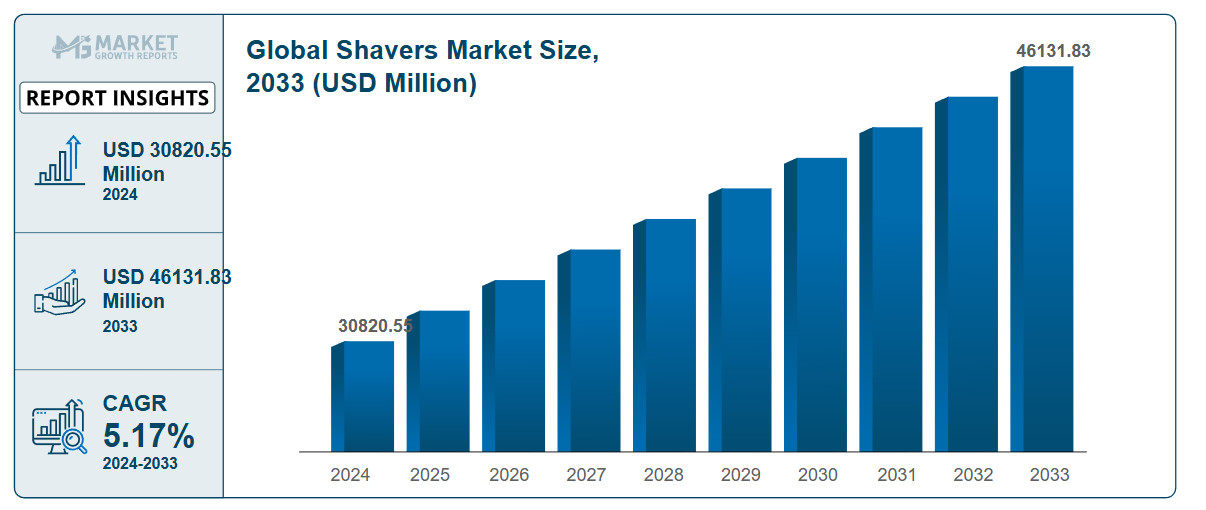 Source — www.marketgrowthreports.com
This “perfect business” reached a high point in 2005, when P&G acquired Gillette for a staggering $57 billion. The deal is still considered one of the most expensive acquisitions in the history of the global consumer goods industry. It demonstrated the razor category’s financial value and cemented the industry’s concentration.
The same stability appears to have slowed innovation. Since lubricating strips were introduced in the 1980s, razor design seems to have largely stalled.
To maintain high margins and fend off copycats after their patents expired, global giants entered an arms race they called “technology upgrades.” Innovation stayed within the bounds of the original design, with brands adding blades in succession, from two to three and then to five and six. Progress came in ever smaller increments.
Yet a market as entrenched and seemingly short on new ideas as shaving can offer some of the biggest openings. That gave Liran, a new-generation consumer brand, a chance to rethink the category.
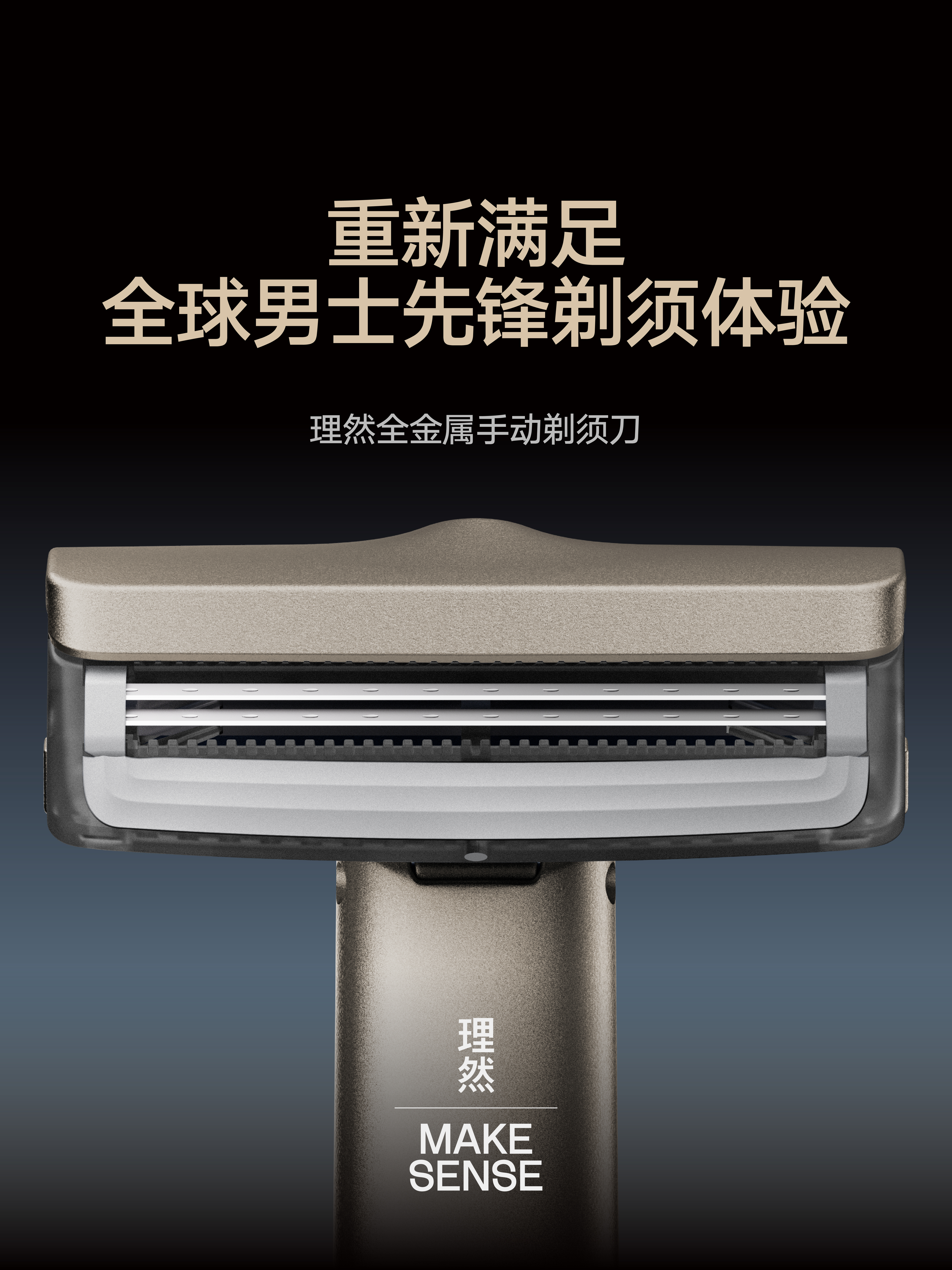
Earlier upstart brands looked for openings the giants had left behind. This time, Liran chose to compete head-on in the core of the market and take on the incumbents across the board.
In its sixth year, Liran set out to make the difficult transition into a mature brand by challenging entrenched industry practices across strategy, consumer experience, product design, and branding.
01. A “boring” market and an asymmetric opportunity
To understand why Liran chose this moment to enter a market that seems closed off behind an “iron curtain,” it helps to start with how fundamentally China’s razor market differs from the global market. The numbers point to a deeper mismatch between what suppliers offer and what consumers need.
In Europe and the US, manual shaving accounts for 80% of the market and electric shaving for 20%. In China, those proportions are reversed, with electric shaving dominant.
That stark difference has often been attributed to the idea that Chinese consumers are lazier and prize efficiency more. A fast-paced lifestyle has certainly made the promise of an electric shave in 30 seconds popular. There is more to the story.
Limited supply is the root cause of that pattern in demand. Chinese consumers appreciate the close shave a manual razor offers. What’s scarce is a well-made, affordable manual razor that shaves gently and suits sensitive skin.
One factor is the limit to how close an electric razor can shave. Its design puts a physical barrier between blade and skin, even if the foil is just 0.05 mm thick. That keeps electric razors from matching the closeness of a manual razor, which can cut hairs at the base or even below the skin’s surface.
Research indicates that 65% of electric razor users are dissatisfied with the shave they get. They find that even the thinnest foil leaves stubble behind. As Chinese men pay closer attention to the finer details of grooming, settling for a shave that is “close enough” is giving way to a strong desire to upgrade.
Manual razors, meanwhile, have long seen only incremental updates. Manufacturers have stuck to the same approach to innovation, leaving users with a poor shaving experience.
Manual razor brands such as Gillette have followed a steady progression in blade count, from twin-blade razors in the 1970s to three-blade models in the 1990s (Mach3) and later to five-blade models (Fusion). More blades meant higher prices. The brands taught consumers a simple equation. More blades = a more premium shave = a closer shave.
But does that hold up?
Shaving creators on social platforms such as Bilibili have begun to question that logic, arguing that adding a third blade or more does little for closeness and can make skin irritation more likely.
 Source — Bilibili creator “Wet Shaving”
Global giants have long held 70% of China’s manual razor market. Their products are largely designed for European and American users, who tend to have softer facial hair and more pronounced facial contours. Chinese men tend to have coarser, stiffer facial hair and flatter contours, with more closely spaced sensitive bumps such as blackheads and pimples. That can make it easy to nick the skin, leaving users anxious about cuts.
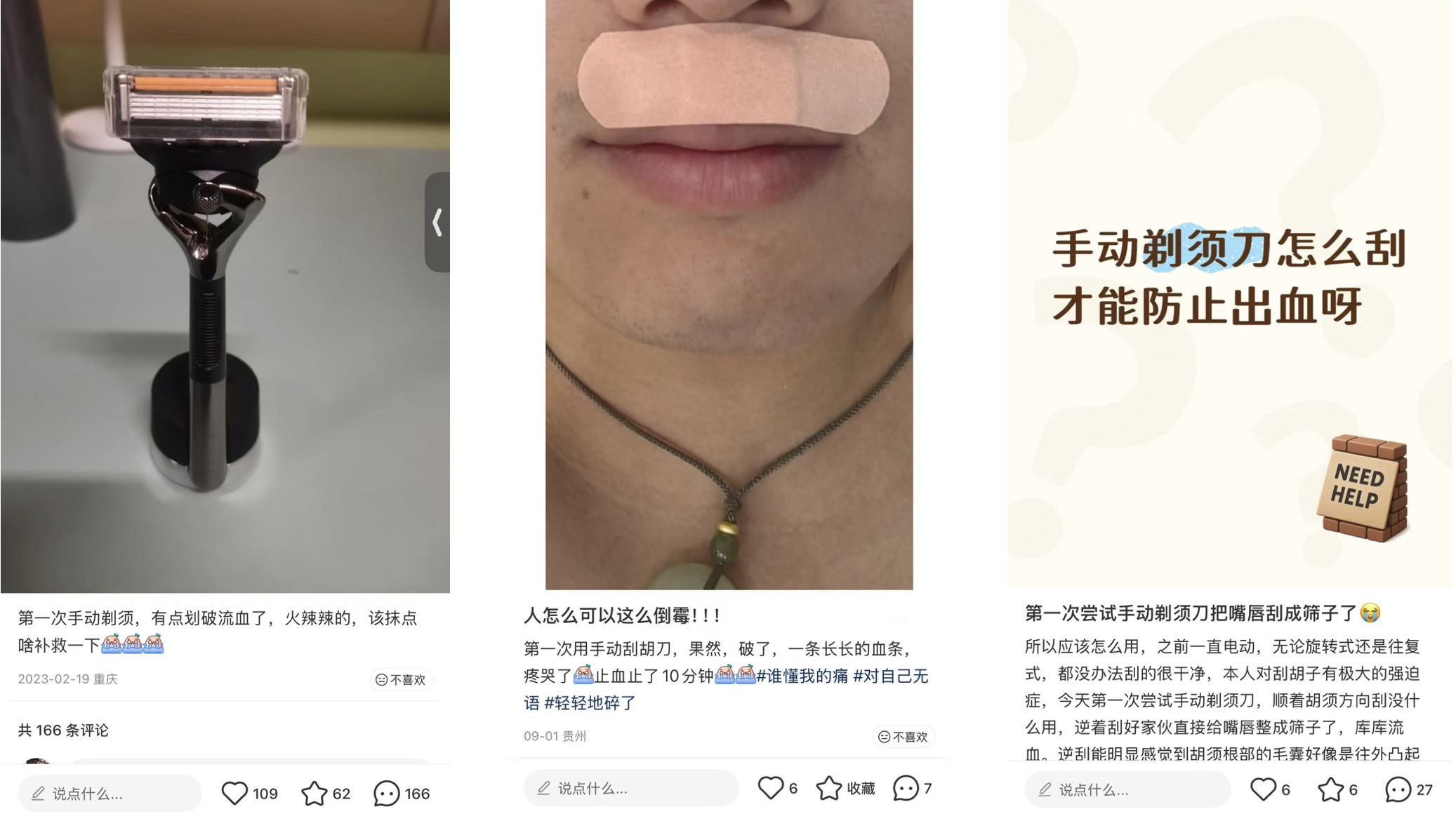 Related posts by Xiaohongshu users
Academic research backs up this observation. Research from Wake Forest University in the US found that in a two-blade shave, each hair is tugged and cut at most twice. Compared with a five-blade razor, which makes more successive contacts, a two-blade razor significantly reduces the irritation that repeated tugging causes at the follicle, addressing a source of razor burn.
Although research and user experience both suggest diminishing benefits from adding blades, manual razors have gone from two blades to five, six, or seven, and electric razors have likewise gone from one head to three, five, or seven. The competition has come down to a single, seemingly pointless metric.
As The Innovator’s Dilemma notes, giants in mature industries tend to pursue “sustaining improvements” along established technological paths. Those changes yield diminishing returns for users. Across manual and electric razors alike, the experience has changed little, and the higher the price, the worse the value can feel.
There is also a gap between China’s manufacturing strength and the influence of its brands.
China is the world’s largest blade exporter, and it produces more than 60% of the world’s low-end disposable blades. That figure reflects production capacity, while Chinese brands have yet to gain comparable clout. With limited innovation in blade design, Chinese manufacturers have largely remained in the low-end segment or in contract manufacturing. They have yet to develop products that can compete head-on with the global giants.
Together, these conditions created an opening for Liran.
Drawing on six years in men’s personal care, Liran went back to what users need most and reconsidered how to design a product that delivers a close manual shave, feels comfortable on the skin, costs little to use, and looks good.
Liran is using China’s increasingly mature manufacturing supply chain to develop an original Chinese design of its own.
2. Putting skin first with fewer, better blades
Liran saw an opening in the industry’s widespread belief that more blades make for a better manual shave. The company asked a counterintuitive question. If two blades can do the job, why add three more and put extra stress on the skin?
From a mechanical standpoint, multiple blades can deliver a closer shave through the “hysteresis effect.” In a five-blade cartridge, however, the first two blades to contact the skin do the effective cutting. As those two blades lose their edge, the remaining three offer little benefit. They can scrape the skin’s outermost layer unnecessarily, leading to redness, swelling, stinging, and razor burn.
Liran made the needs of the skin the starting point for product design.
That shift led Liran to focus on balancing shave closeness with what the skin can tolerate. Its pioneering “2+2+1” cartridge design reduces blade damage to the skin and aims to strike the best balance between closeness and comfort.
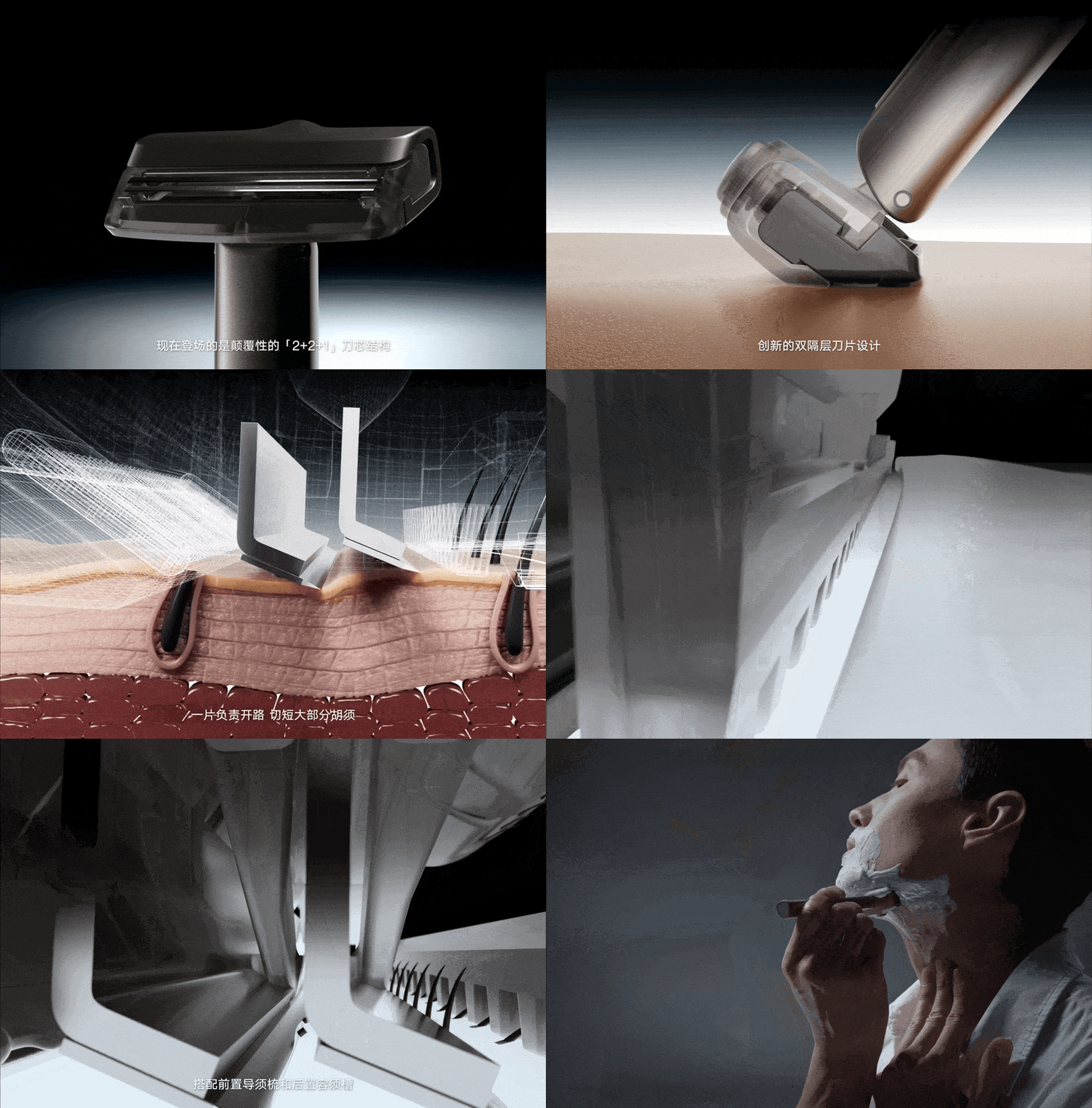
Liran departs from mainstream blade geometry with a distinctive “negative exposure” design, setting the blade edges slightly below the plane of the razor head. When the head is pressed against the skin, only the hair and the skin that bulges under pressure meet the blade edges, reducing the risk of nicks.
The ergonomic, spring-loaded blade design lets the head automatically adjust to facial contours and move over small raised areas such as pimples and rough stubble for a smoother shave.

Liran started out researching the fundamentals of men’s skin, so it brought its skin care expertise to the razor. Its patented oversized lubricating strip contains activated charcoal, B5 (panthenol), and sodium hyaluronate. The strip provides enough glide and protection even when users are in a hurry and forget the shaving foam, making the razor safer and more forgiving to use.

Details in the way users handle the razor reflect the same attention to the shaving experience. To address a major pain point in China’s manual razor market and make shaving easier and more enjoyable for beginners, Liran designed a patented multifaceted handle and a head that pivots through 30°. The design helps users apply pressure at the right angle regardless of grip and reach tricky spots such as the chin and the area just under the nose.

In Brandstar’s view, combining skin care expertise with thoughtful product design is a natural extension of Liran’s six years in men’s personal care. Its earlier hits, including its volumizing hair mist and facial cleanser, used thoughtful design details to make the products easier to use and the routine more satisfying.
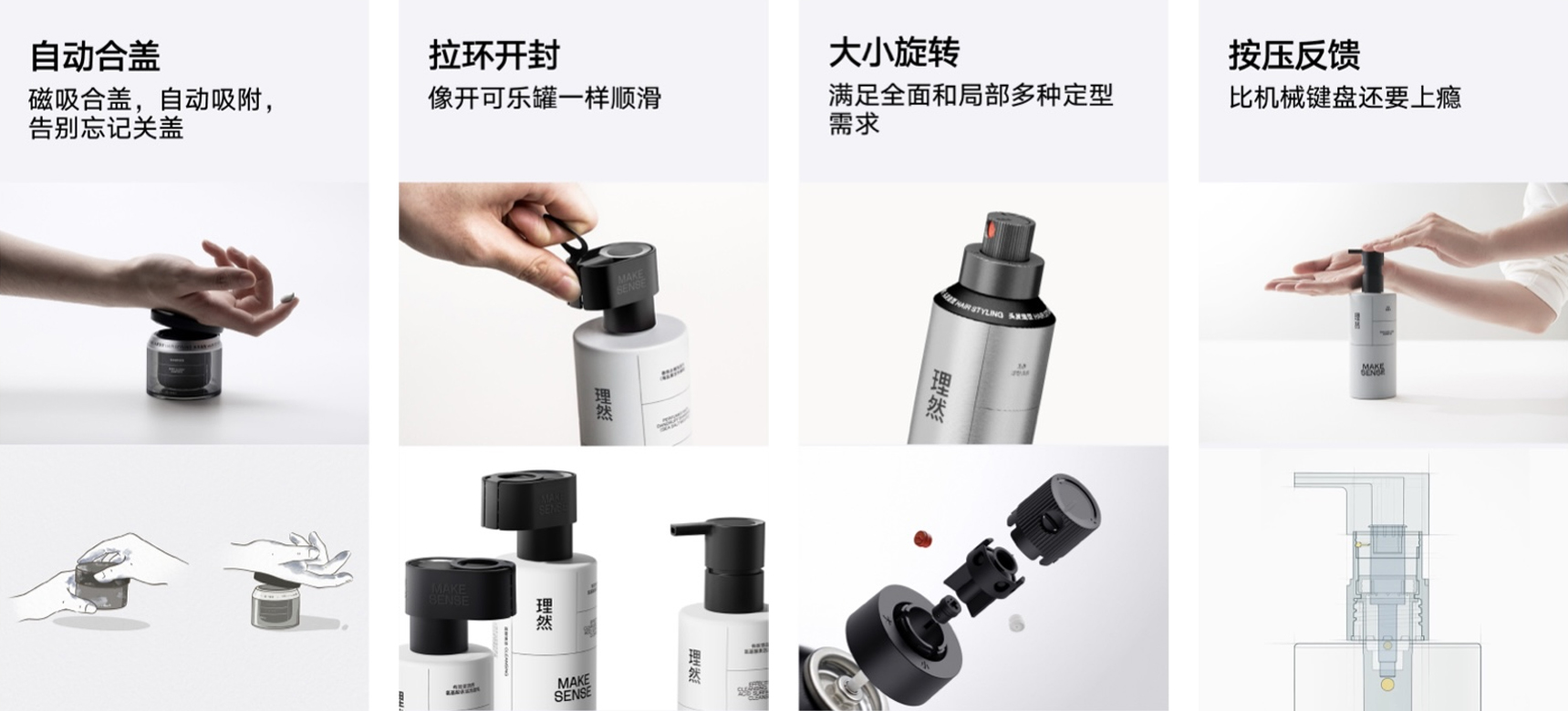 Examples of how Liran improved ease of use in earlier products
03. Why shaving was Liran’s natural next step
Liran’s launch of an all-metal manual razor could easily be read as routine category expansion or an opportunistic search for growth by a new consumer brand whose traffic has peaked. Brandstar sees the launch as a sign that Liran is sticking to its strategy as it matures.
The move follows directly from Liran’s technical capabilities in grooming and its broader brand strategy.
Liran draws its confidence from six years of sustained focus on a single sector, where expertise has compounded over time. Before launching the manual razor, Liran had already gained leading positions in several segments, including men’s styling products such as hair clay, volumizing mist, and hairspray, and facial care products such as cleansers, skin care sets, and complexion-enhancing creams. Frost & Sullivan certified its market standing.
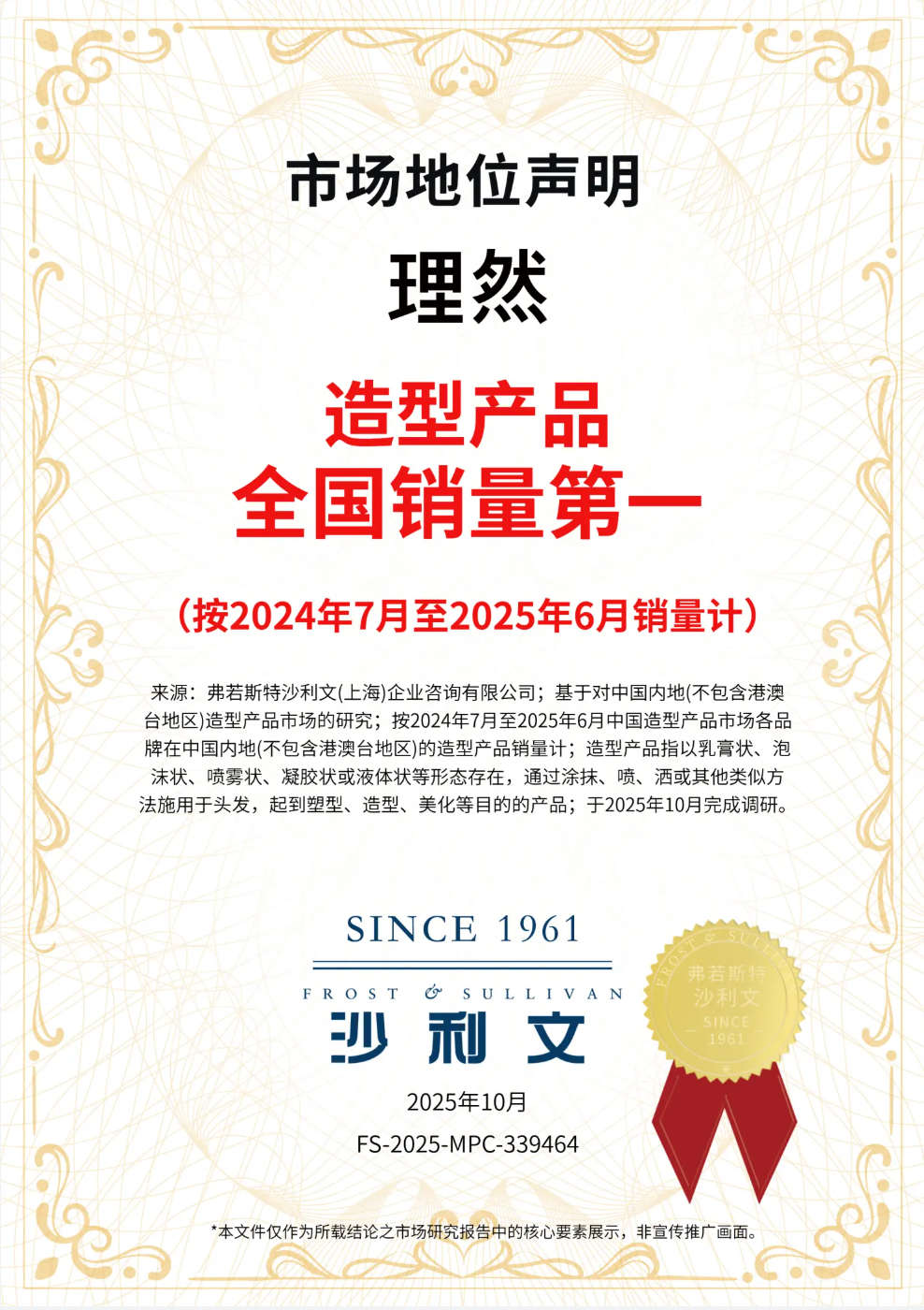
That sustained focus gave Liran a deep understanding of Chinese men’s skin, grooming habits, and even psychological needs. It also helped the brand build a sizable customer base and earn its trust, laying a solid foundation for entry into a new category.
From a category strategy perspective, razors are a key link between men’s styling and skin care.
For a brand that understands how much oil men’s facial skin produces, how thick its outer layer is, and where it tends to be sensitive, developing a razor is a natural extension. That skin care perspective gives it an edge over the traditional approach centered on mechanics.
While traditional razor brands were still focused on steel hardness and blade count, Liran had already turned its attention to delivering a close shave while protecting the skin barrier. That shift helped it move beyond competition over specs and identify a problem the giants had overlooked. It fits Liran’s strategy of serving the same customers and addressing their deeper needs.
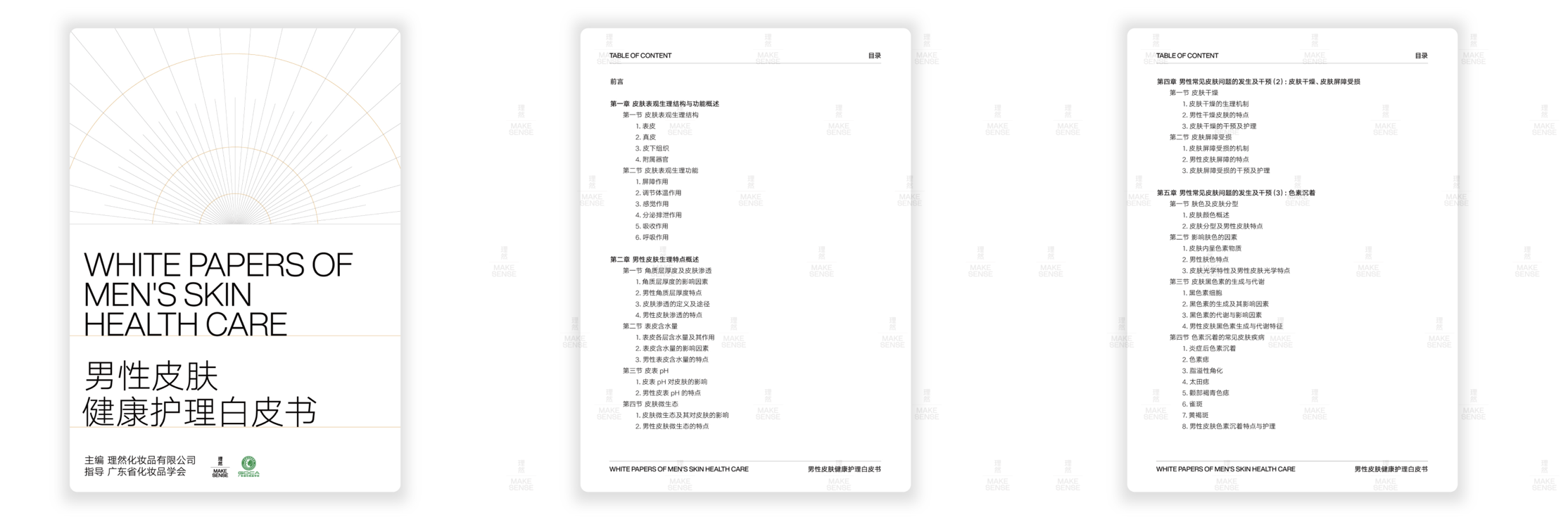
Beyond addressing problems for men buying razors for themselves, Liran spotted a long-overlooked opportunity in men’s grooming. Women often make the purchase decisions in a market geared toward men.
Often described as “the most important item a man will ever own,” the razor has long been a go-to gift for women buying for men. In that common gifting scenario, 200–400 yuan is a mainstream price range with strong sales potential. Yet the range has long been underserved.
Most electric razors in that price range are entry-level models that cover the basics. Manual razor options are limited, and few come with premium gift packaging or accessories, making it hard to find a razor that feels presentable as a gift.
Liran targeted this gap with a razor gift set that includes a full range of shaving accessories, from a stand and leather razor case to a travel grooming bag. The set turns an everyday tool into a polished, presentable gift, giving recipients an unboxing experience and a sense of ritual when they use it.
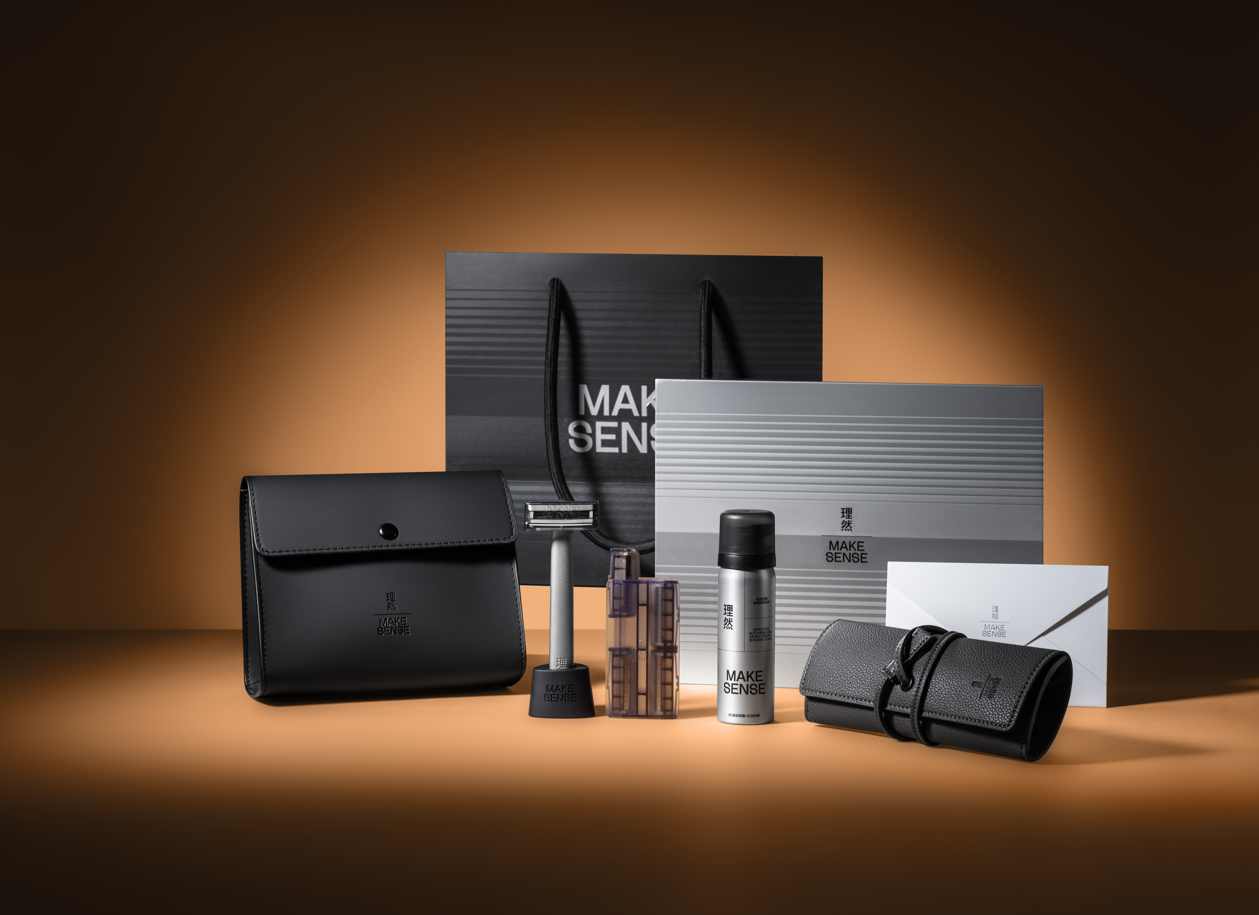
The gift set also broadens Liran’s sales strategy. The brand can tap a larger market for growth by expanding from selling individual razors to men to becoming a brand women consider when shopping for gifts.
To that end, Liran will open its first pop-up dedicated to gifting in Shenzhen this December. Having established a presence across major brick-and-mortar retail channels nationwide, the brand is now testing a physical retail format of its own.
For Liran, the pop-up brings the brand experience into a physical space and gives its all-metal manual razor an ideal showcase. Customers can experience the razor’s key advantages firsthand and see how Liran’s full personal care range fits into their grooming routines.
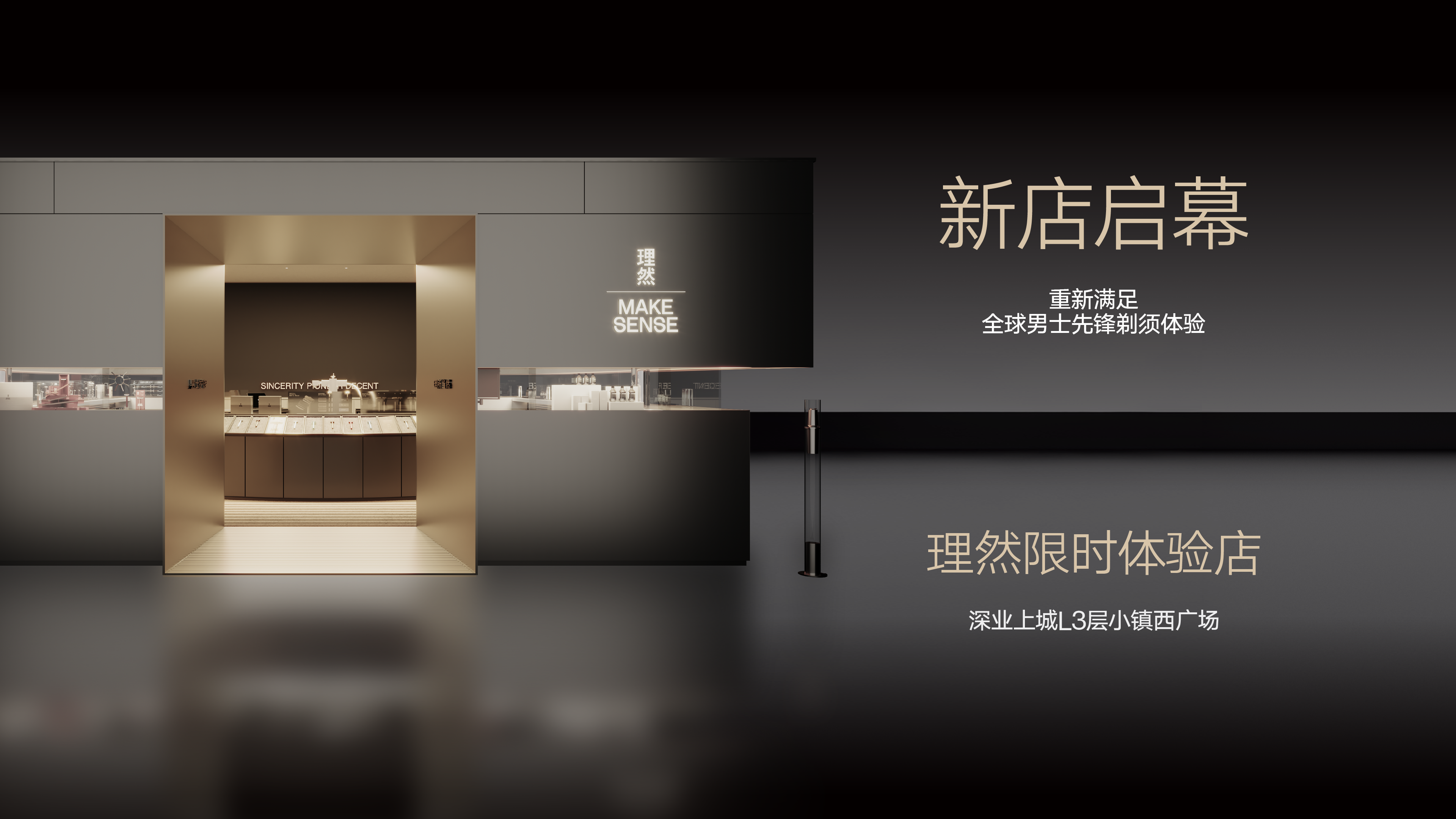
With this immersive retail experience, Liran is building a more durable foothold than online traffic alone can provide. That physical presence gives the brand a foundation for competing with industry giants in the mainstream market over the long term.
04. Closing thoughts
Viewed over a longer horizon, the launch of Liran’s all-metal manual razor could mark a coming of age for the generation of emerging consumer brands that rose to prominence in recent years.
Over the past few years, we’ve seen countless new brands take off by capitalizing on easy access to online traffic or positioning themselves as affordable alternatives to big names, only to fall just as quickly when that traffic dried up. Liran’s choice shows how this generation of consumer brands has taken different paths as it matures. Its new shaving product, built on six years of work, marks a departure from an era when brands relied on shortcuts to win online traffic.
The implications extend beyond the fate of one product. The launch signals that emerging consumer brands are beginning to compete head-on across the board in mature markets with higher technical barriers to entry and a tighter grip by industry giants.
Liran challenged the industry’s reliance on multiple blades, went upstream in the supply chain to customize production lines, and developed a new shaving product better suited to Chinese consumers. In Brandstar’s view, Liran’s effort to rethink the product and break the incumbents’ hold pushes product performance as far as possible. It also puts the brand’s ability to reshape its supply chain, improve organizational efficiency, and gain traction across sales channels to an extreme test.
Whatever the outcome, Liran offers Chinese brands a valuable example. Even against a seemingly unbeatable rival, genuine innovation, an asymmetric strategy, rigorous product thinking, and years of brand building can help challenge outdated industry rules.
Perhaps even a century-old “perfect business” is worth rebuilding with an original approach from China. BRANDSTAR