A flower in bloom for over 60 years. How did Marimekko build a brand world through prints?
A brand world shaped one floral print at a time.
In 2025, Marimekko kicked off the Asian tour of Field of Flowers with a new floral print at a limited-run exhibition at the former residence of Ho Tung in Shanghai.
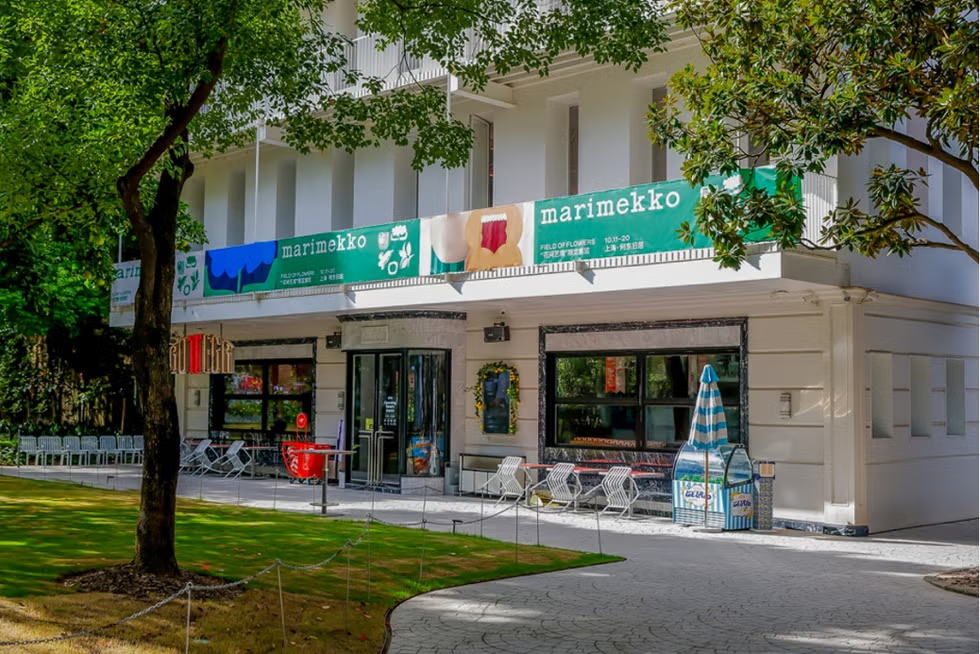
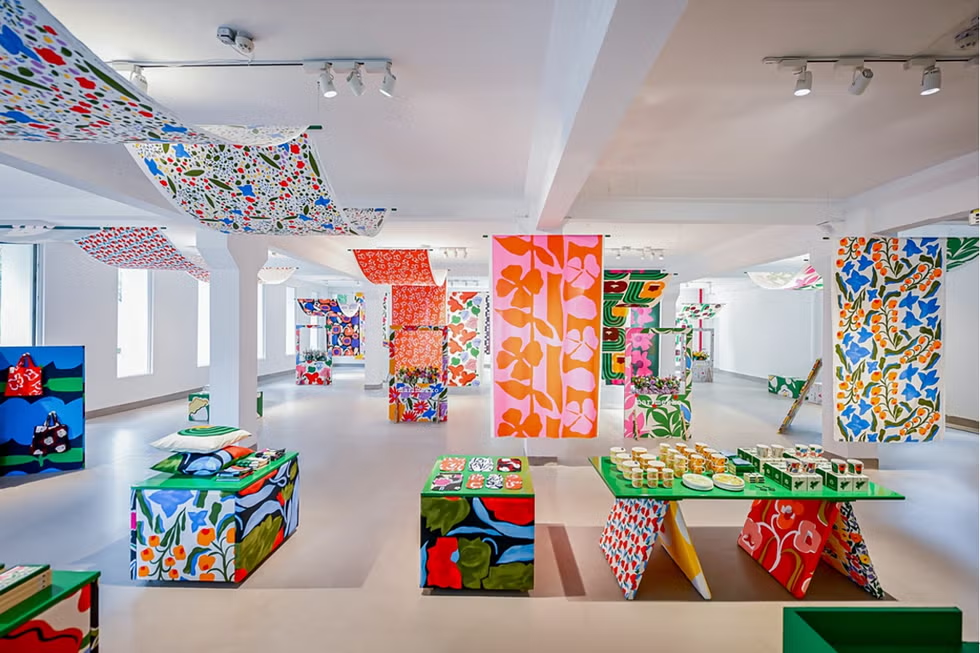
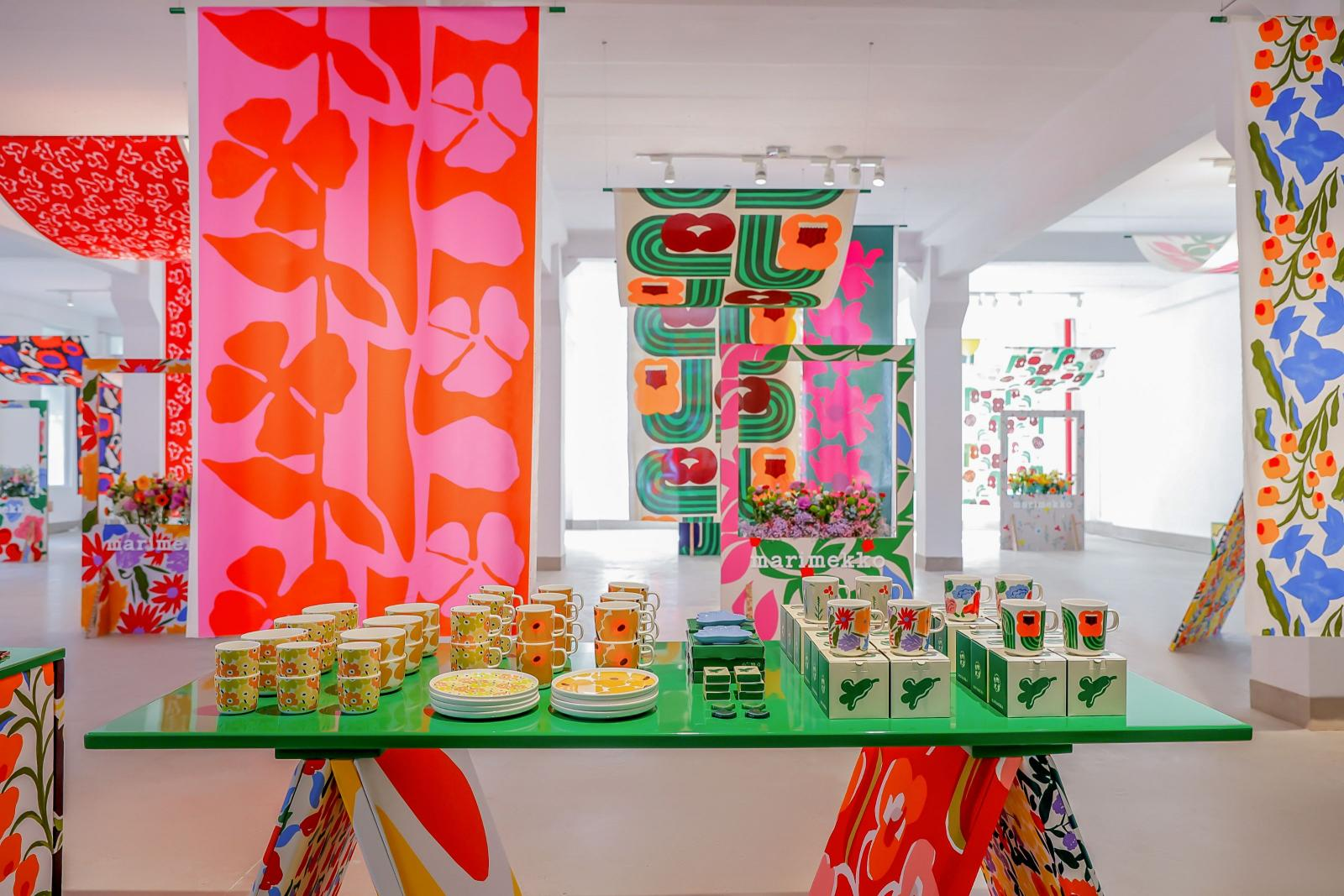 Field of Flowers exhibition at the former residence of Ho Tung in Shanghai
From the global pop-up tour marking Unikko’s 60th anniversary and an immersive space at Shanghai’s iapm mall to print-covered trams rolling through Hong Kong, the Finnish brand has always relied on its distinctive prints to build recognition and bring its vision for everyday life to audiences, without relying on a conventional logo.
Behind these projects are more than 60 years in which Marimekko and its prints have shaped each other. The prints are design elements, the brand’s most recognizable signature, and its primary means of communicating what it stands for.
What began as patterns on a designer’s drawing board became visual signatures that defined Marimekko’s image and gave customers around the world an emotional connection to the brand. The prints ultimately helped Marimekko expand beyond Finland and build a business spanning multiple categories.
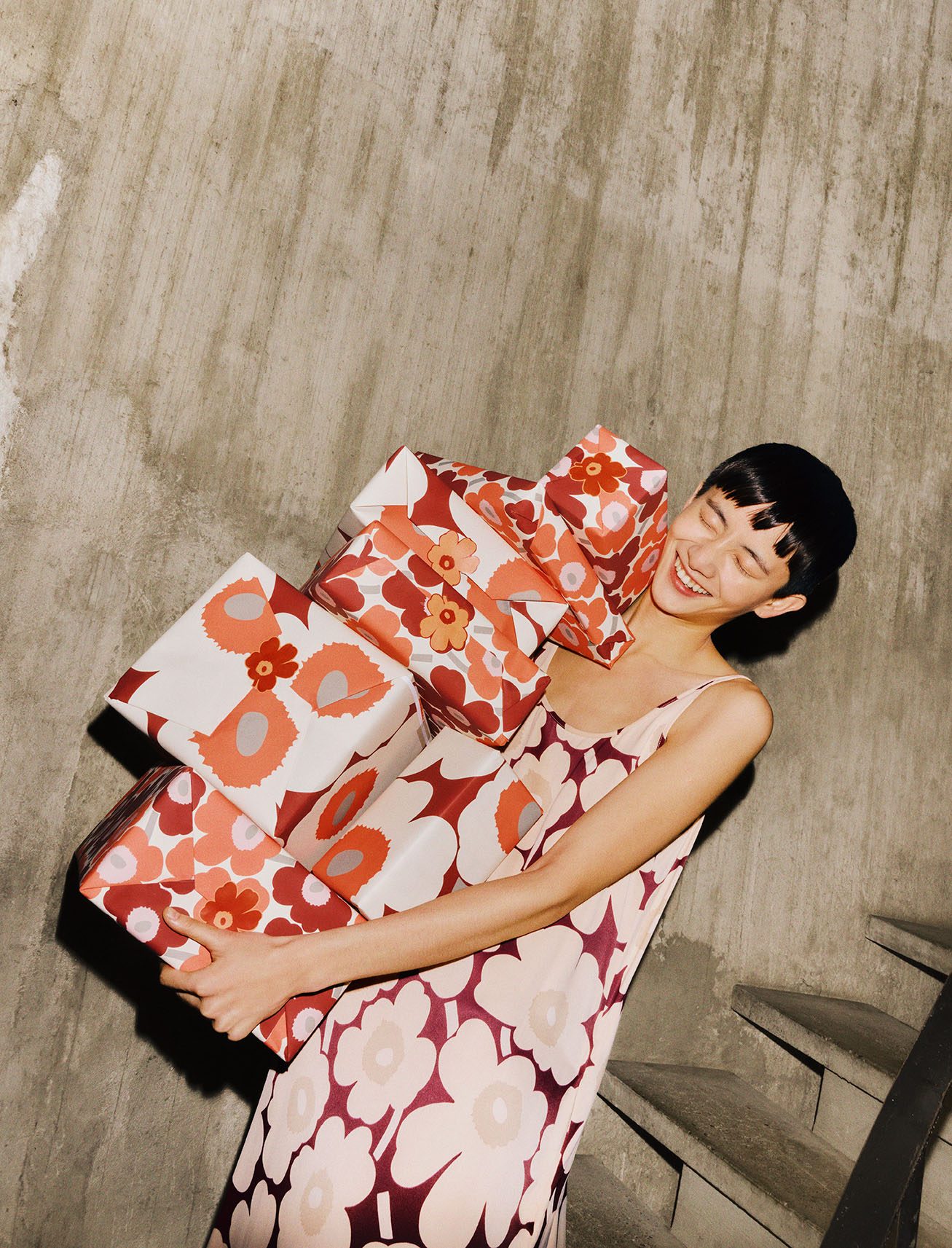
Brandstar has previously analyzed evergreen brand products such as Air Jordan and Chanel No. 5. These breakout hits also embody a brand’s values and shape how consumers think about it. Marimekko’s prints serve the same branding functions across products. They are instantly recognizable visual signatures, core brand assets, and a key driver of commercial expansion.
This article looks at how Marimekko’s signature print has kept the brand vital over 61 years and how the motif and the brand have evolved together.
01. How prints shaped Marimekko’s growth
Armi Ratia and her husband, Viljo Ratia, who ran the Printex textile factory, founded Marimekko in Helsinki, Finland, in 1951.
The brand name combines the woman’s name Mari with mekko, the Finnish word for dress. Meaning “Mari’s dress,” it signaled an interest in women’s self-expression from the outset.
From the outset, Marimekko’s design philosophy celebrated the appeal of independent women. Amid the conservative fashions of the 1950s, the brand took a different direction. Abstract prints and saturated colors broke up the visual monotony, while loose silhouettes freed women from restrictive clothing and gave them a way to express themselves boldly.
Prints gave that philosophy its most direct expression. Through the patterns on its fabrics, Marimekko developed a visual language that challenged conservative conventions and conveyed a sense of freedom.
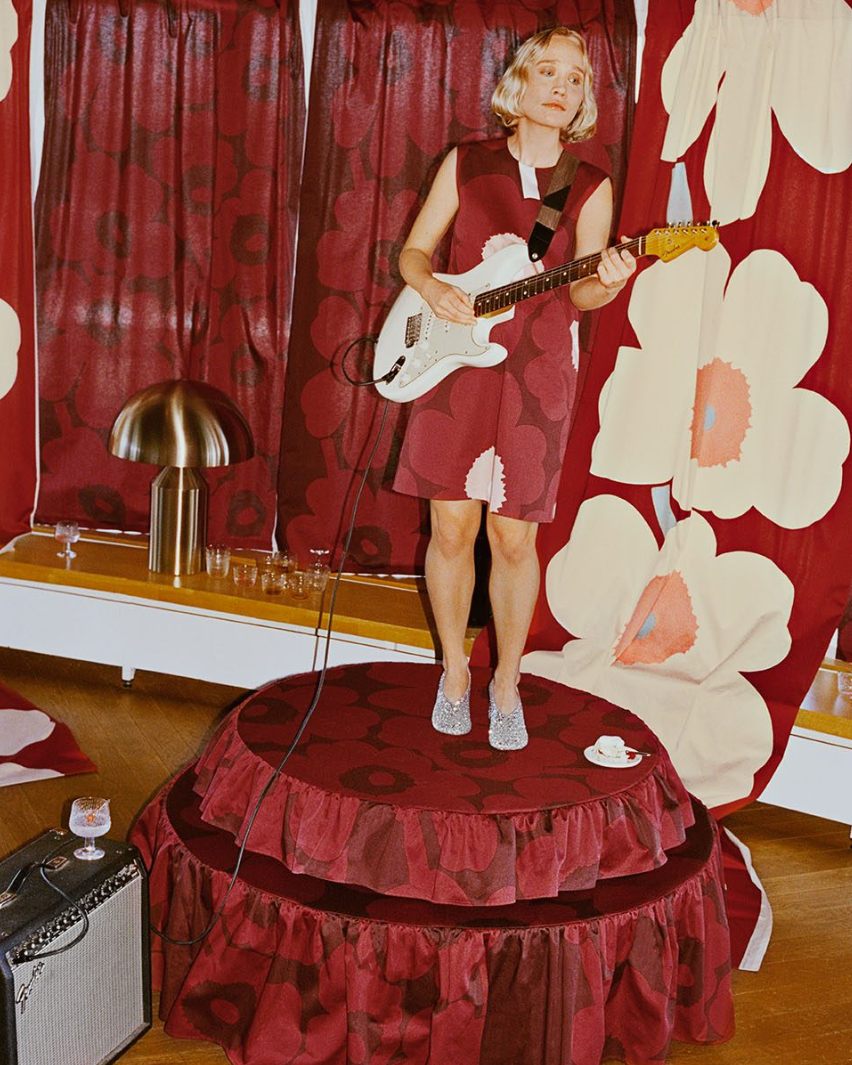
Marimekko has created countless prints over more than 70 years, but it was Unikko, the poppy pattern introduced in 1964, that came to embody the brand and become a core asset. The story behind Unikko and its distinctive look helped define Marimekko’s visual identity and made the connection between its prints and the brand even stronger.
➊ The signature print and the story behind Unikko’s botanical design
Prints are central to Marimekko’s identity and continue to build its brand equity. Unikko is their clearest expression.
Designer Maija Isola created the signature Unikko poppy print in 1964. Its origins lie in a disagreement over floral design.
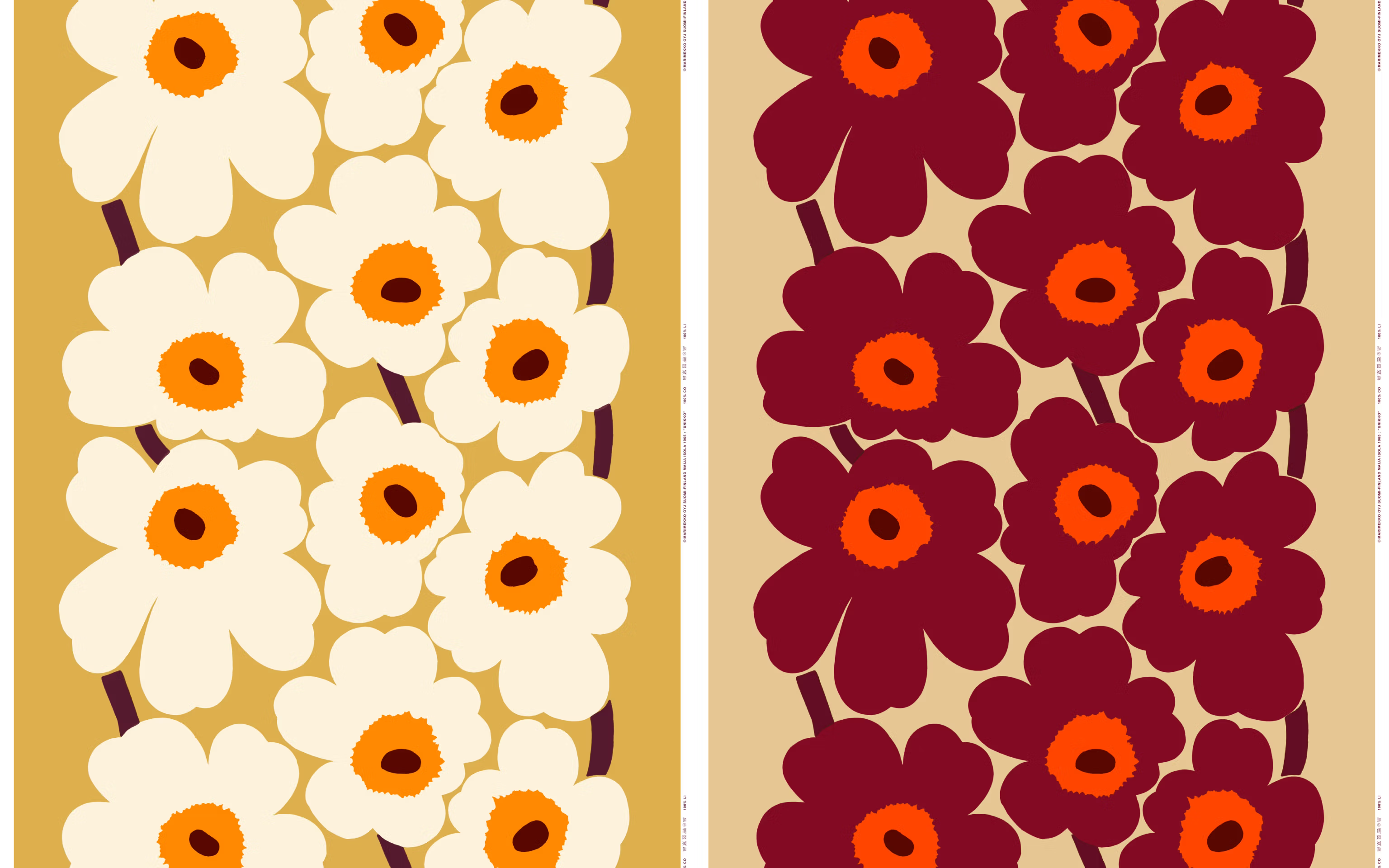 Marimekko’s classic Unikko poppy print
Founder Armi Ratia had explicitly barred floral motifs because she believed a designed pattern could never capture the beauty of flowers in nature. Maija Isola went ahead with a series of flower-inspired prints. The striking poppy pattern drew such a strong response that it broke the ban and became the brand’s most enduring design.
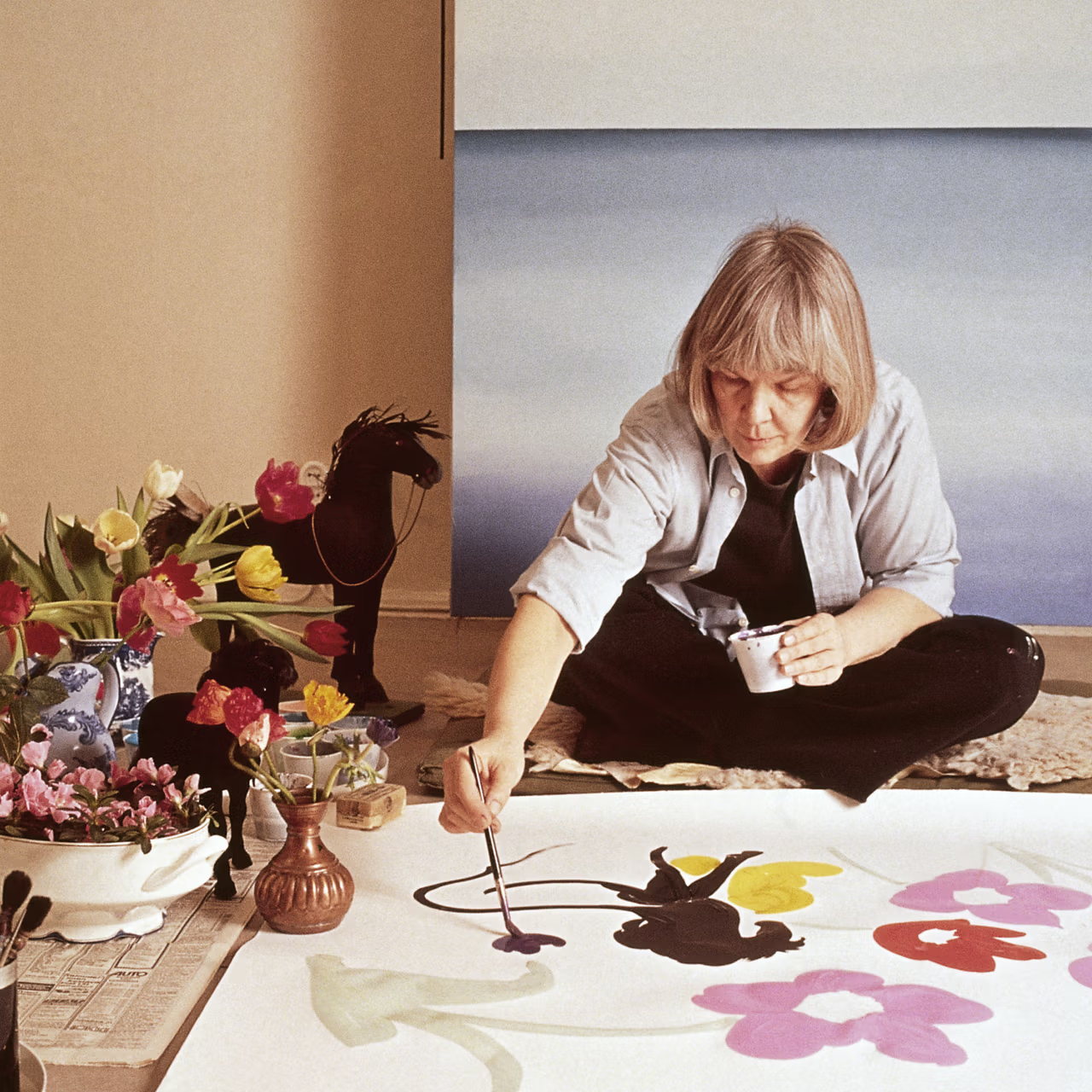 Maija Isola
Marimekko has consistently drawn on plant forms, abstracting them and pairing highly saturated, high-contrast colors to give the patterns a different character across clothing, fabrics, and other applications.
To reinforce its standing in textile print design, Marimekko marked Unikko’s 60th anniversary by publishing Marimekko: The Art of Printmaking. The book surveys the brand’s prints, design philosophy, and production process from start to finish.
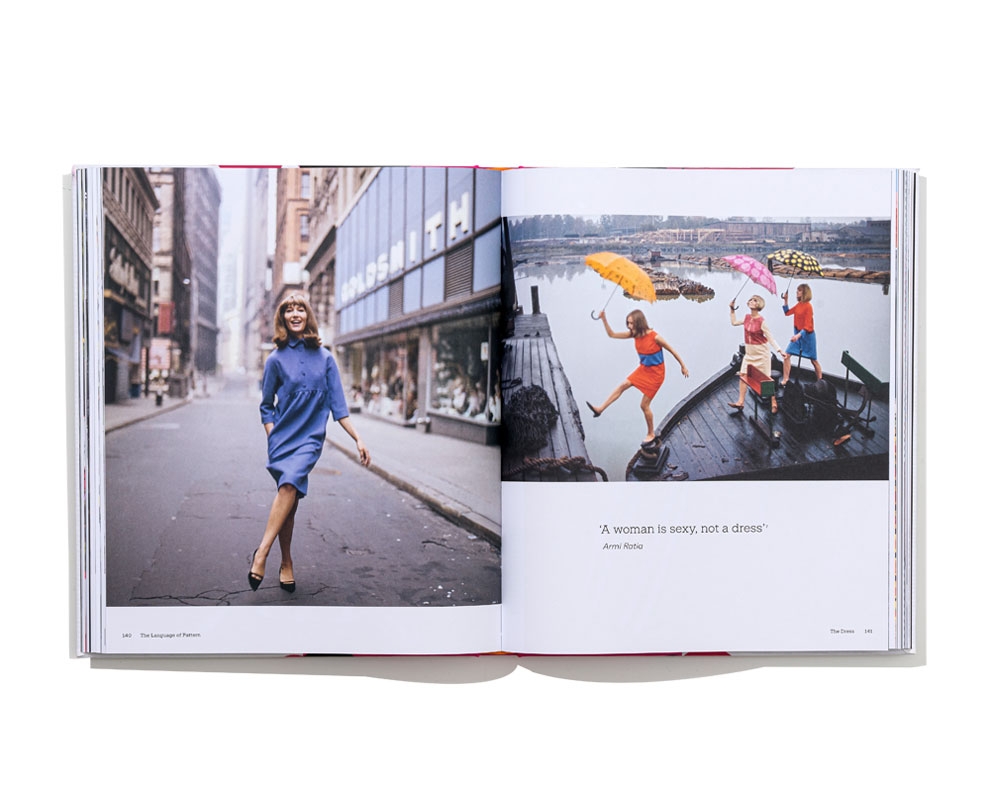
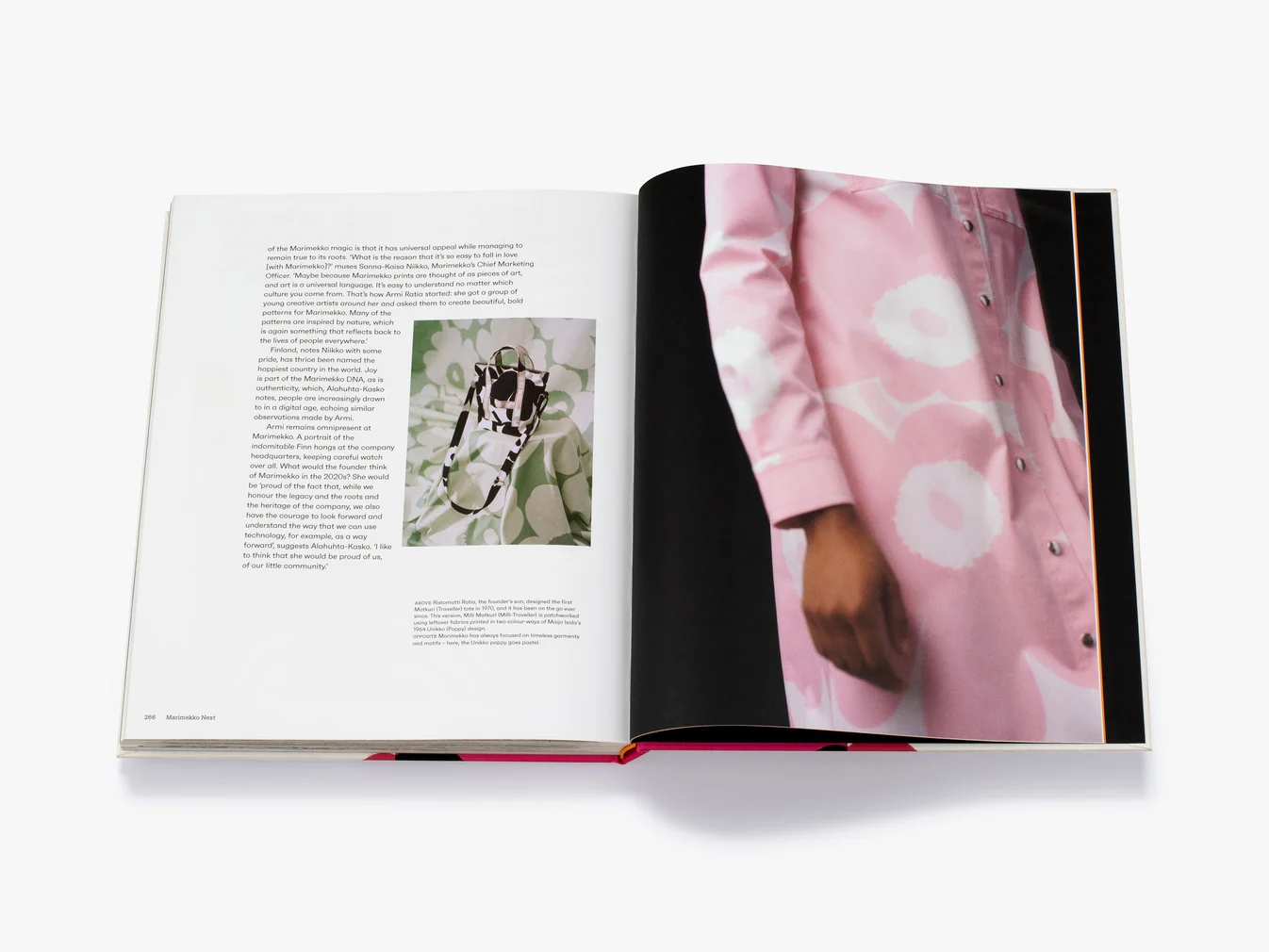
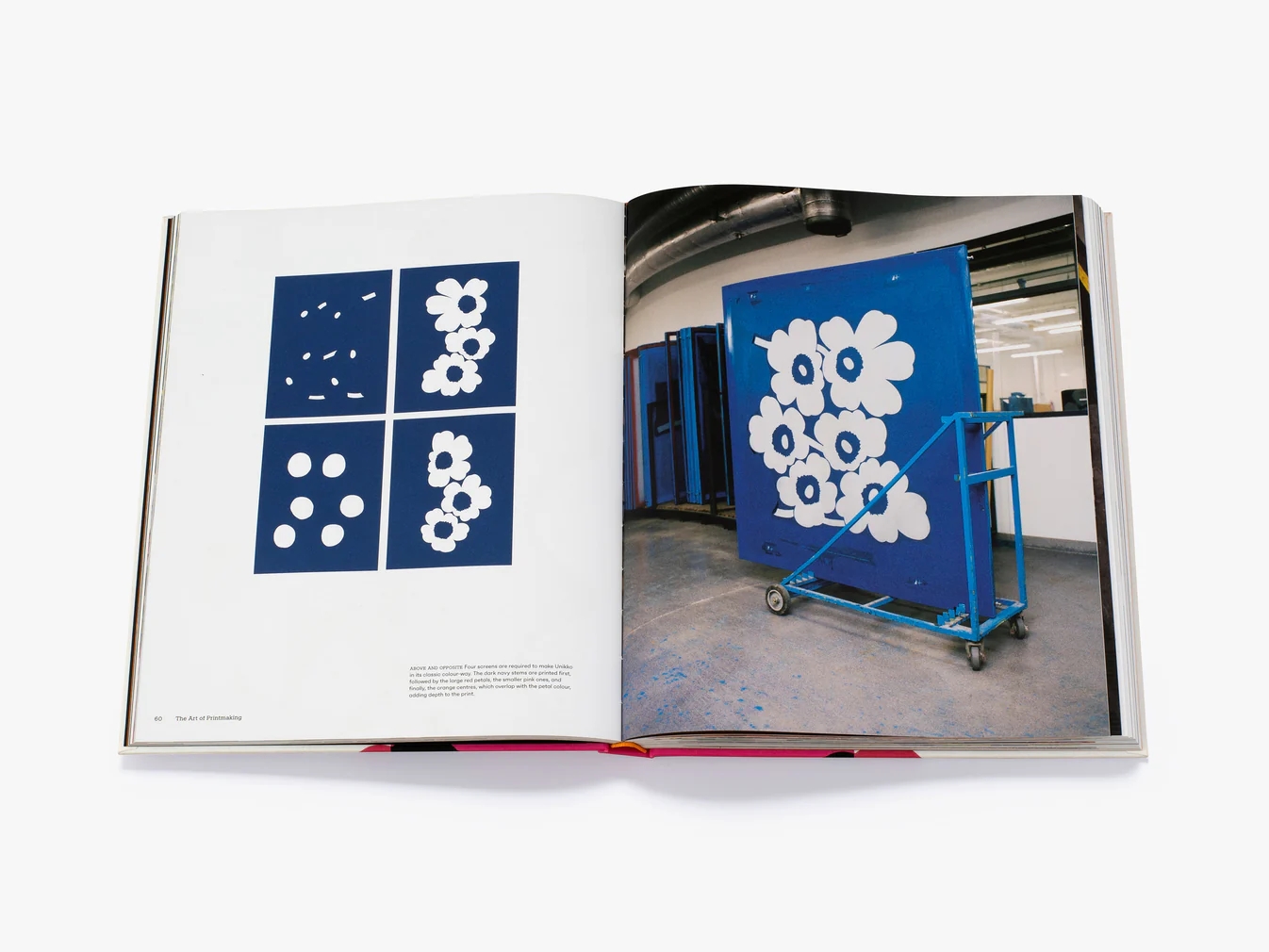 Inside Marimekko: The Art of Printmaking
Technical innovation has also helped keep Marimekko’s prints viable over the long term.
In 1973, Marimekko built its own textile printing factory and installed flat-screen printing equipment, bringing its core processes in-house to ensure color fidelity and pattern precision across its prints. In 2023, it partnered with Rester to turn cutting scraps and surplus fabric from the factory into new fibers and raw materials, making recycling part of its print operations. In 2024, it introduced 3D technology into its design workflow to shorten sample turnaround and reduce emissions during development while maintaining design quality.
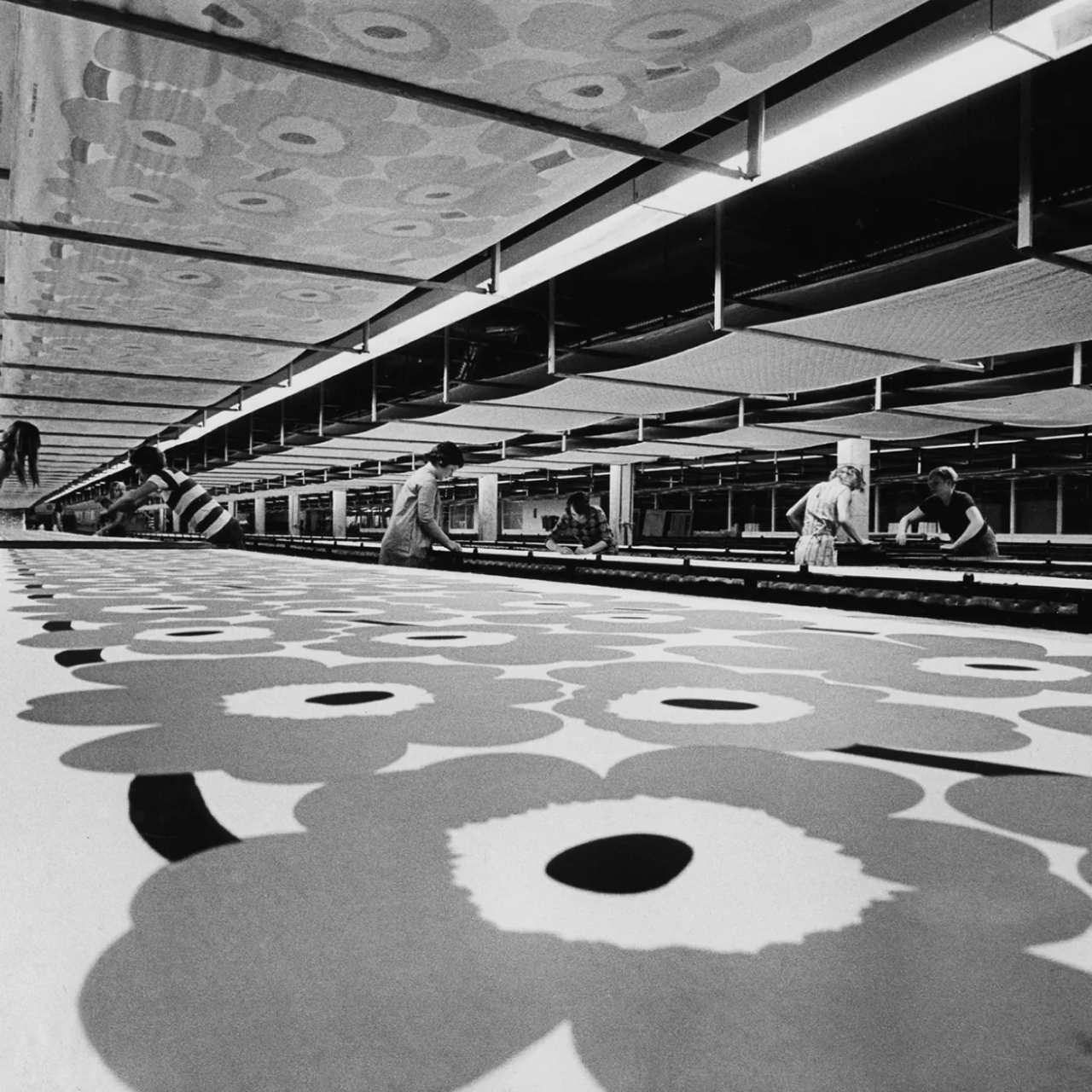 The printing factory at Marimekko’s Helsinki headquarters
➋ Prints as a signature in cross-industry collaborations
As Marimekko’s influence grew, its prints evolved from design elements on individual products into recognizable signatures that support its commercial expansion across categories and partnerships.
Marimekko began by extending its printed textiles from apparel into home goods, tableware, and accessories. The range grew to more than 3,000 products for everyday life at home and on the go.
Expanding across categories made prints a recognizable part of consumers’ everyday routines, reinforcing the association between the patterns and Marimekko.
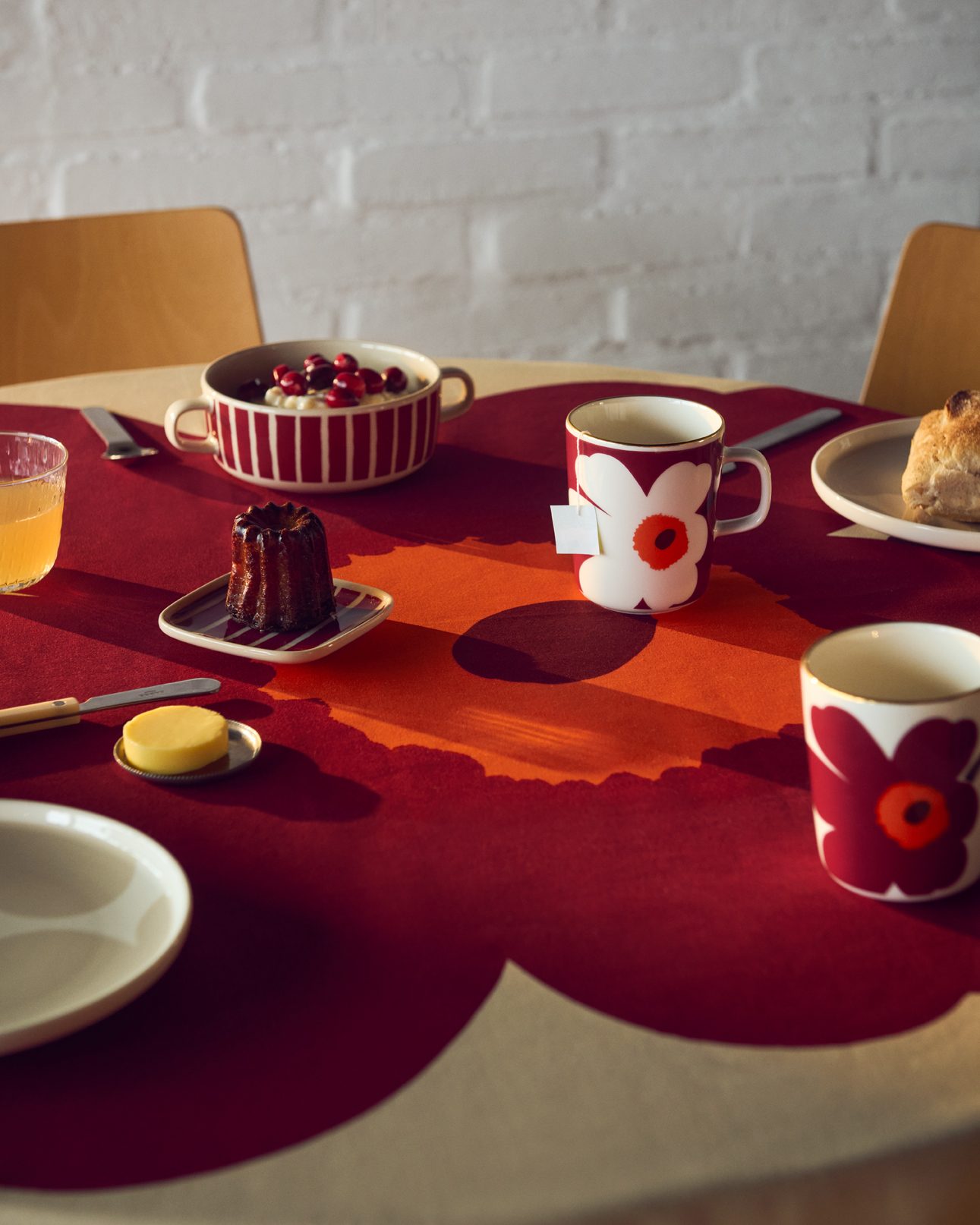
Their recognizability allows the prints to define Marimekko’s image, communicate its culture, and anchor collaborations across industries without a logo. The prints themselves are what make Marimekko an attractive partner, helping the brand find new uses for its designs and reach shoppers beyond its core audience.
- In fashion, Marimekko teamed up with Mansur Gavriel in 2022, pairing Italian craftsmanship with Nordic print design. More recently, it worked closely with Uniqlo on co-branded collections for two consecutive seasons, bringing vibrant Finnish prints to a wider audience through comfortable fabrics and accessible prices.
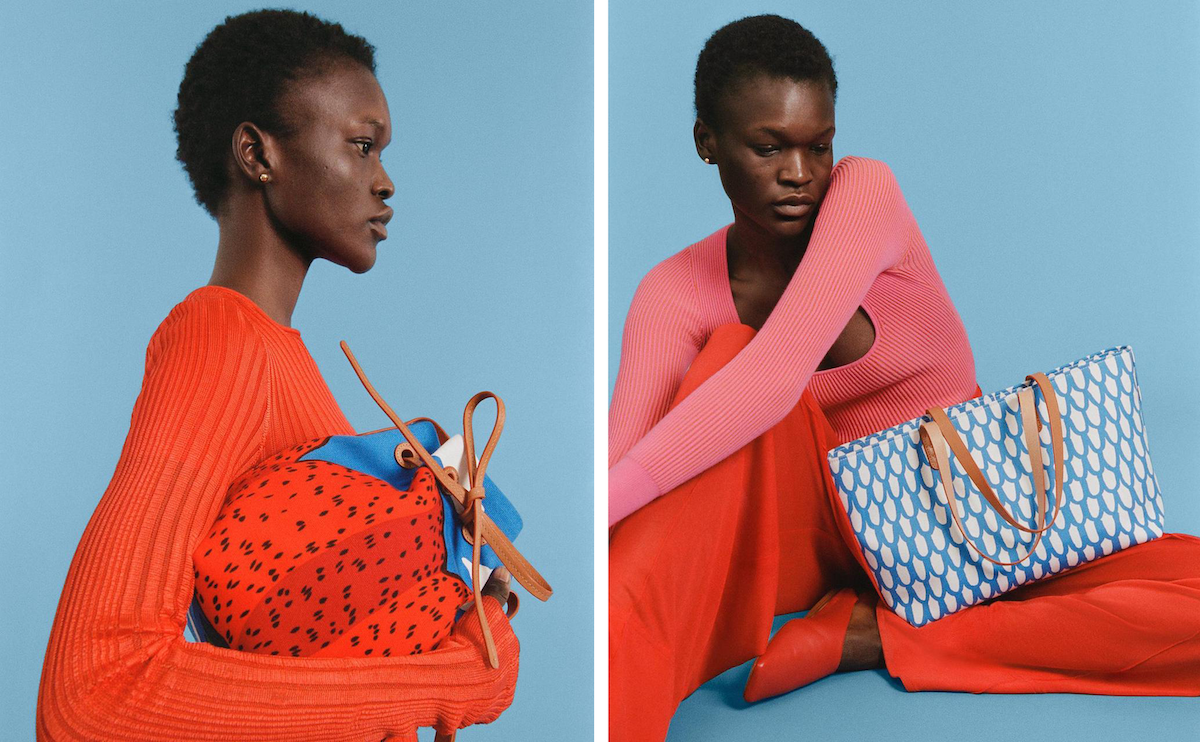
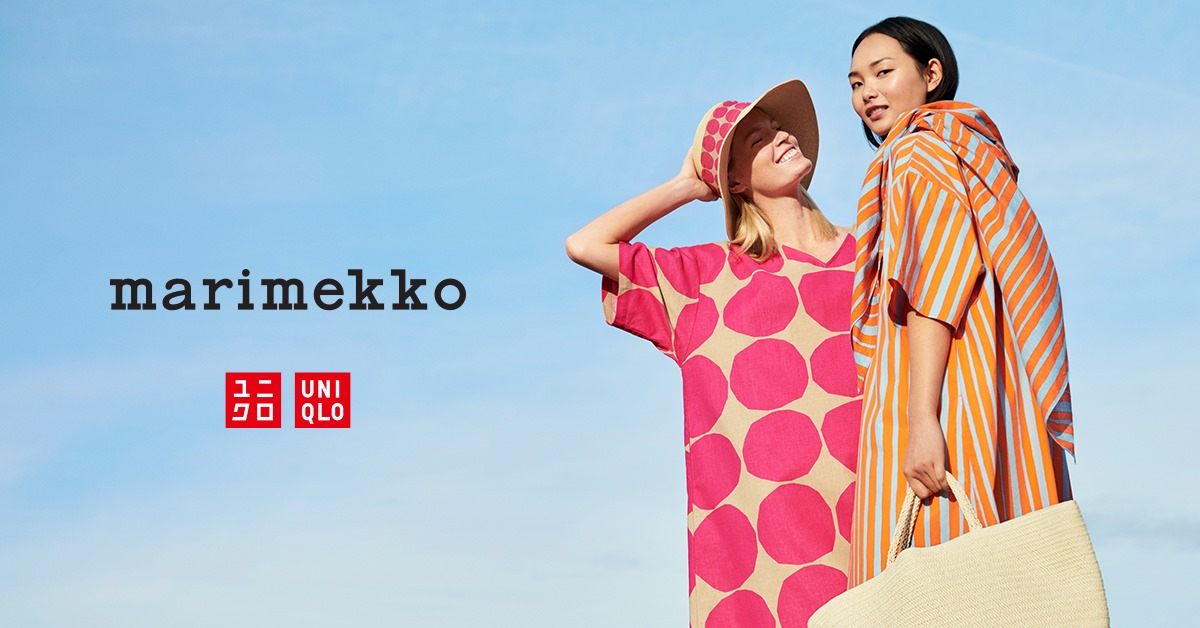 Marimekko’s collaborations with Mansur Gavriel and Uniqlo
- In lifestyle, Marimekko partnered with Blue Bottle Coffee on merchandise in an exclusive Nordic green and Blue Bottle blue color palette. Its BASTUA collection with IKEA drew on nature and sauna culture, bringing prints to furniture, glassware, and other home goods. Marimekko also worked with HEYTEA on co-branded drinks and merchandise such as stickers and tote bags, bringing its designs into younger consumers’ daily lives.
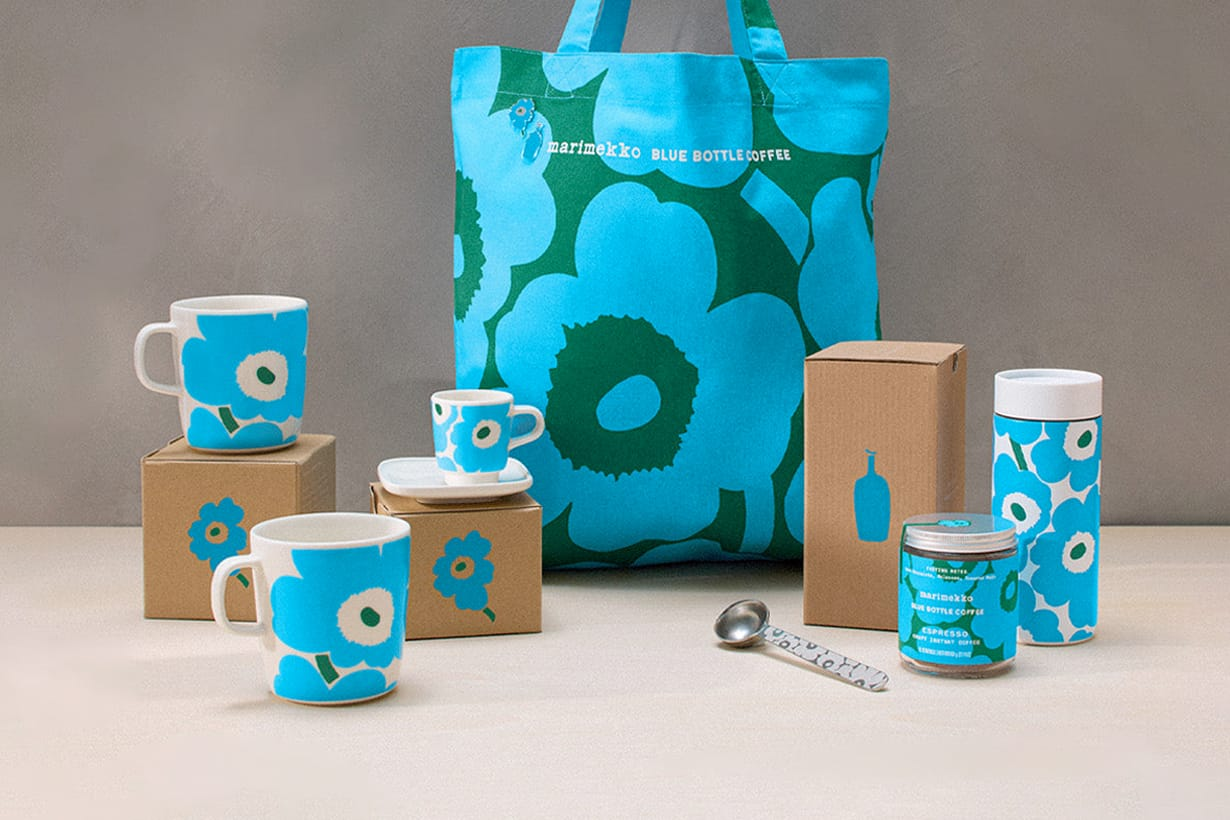
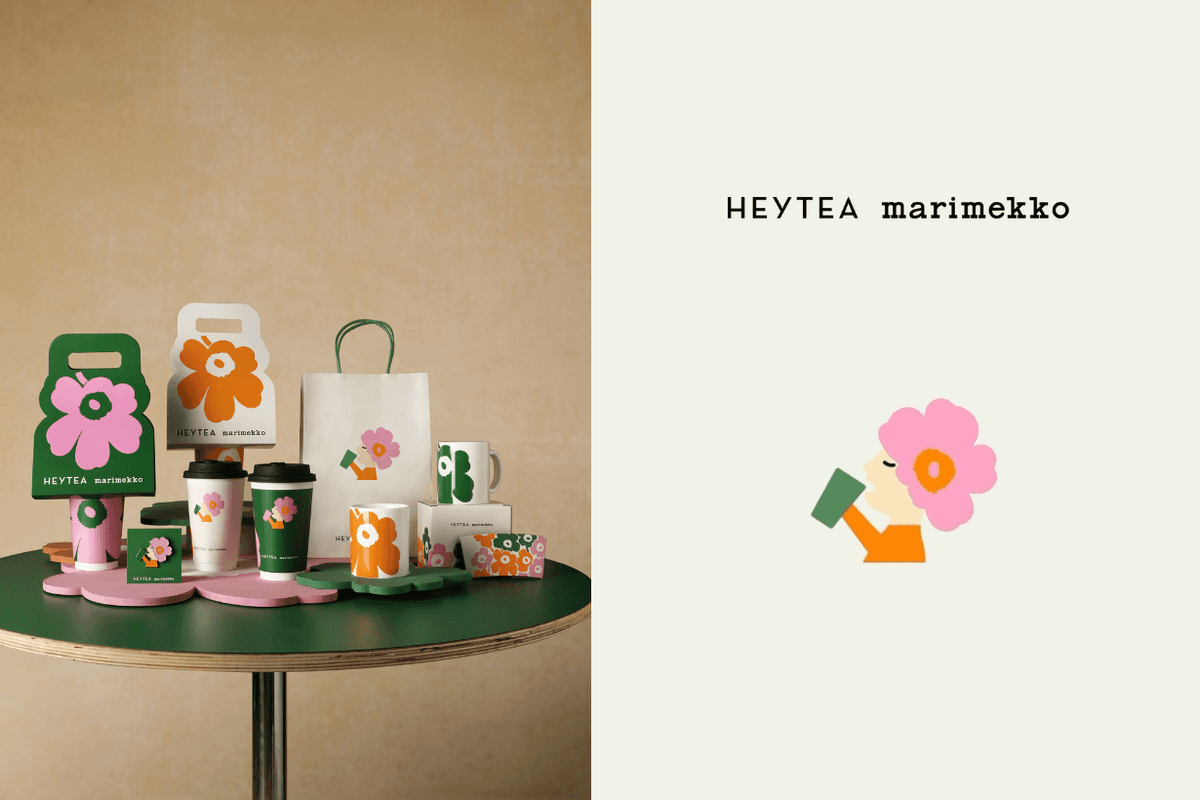 Marimekko’s collaborations with Blue Bottle and HEYTEA
- In sports, Marimekko collaborated with adidas to bring fashion into sportswear and gear through saturated prints. The partnership appealed to sports enthusiasts looking to express their individuality and gave the brand a more youthful energy.
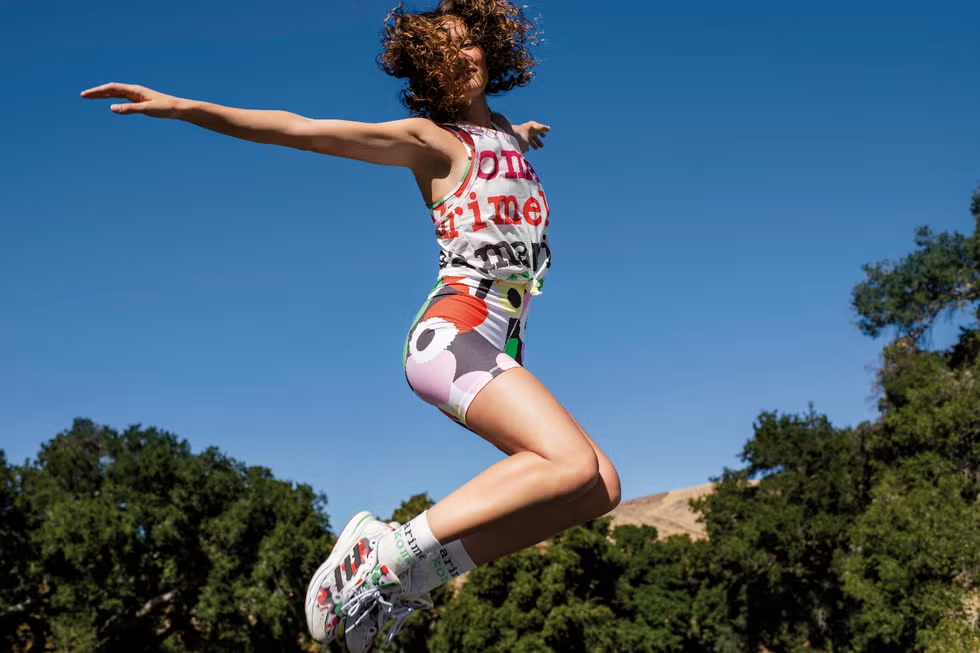 Marimekko and adidas spring/summer 2022 collaboration
These collaborations show how prints give Marimekko a competitive edge and carry its design culture into new markets. Consumers recognize the brand quickly through its prints, while partners can command a premium for products with a distinctive look that gets people talking.
Cross-industry collaborations have also helped Marimekko take its prints into new categories and expand the role they play in everyday life.
➌ How Marimekko’s prints express a lifestyle built around “JOY”
Marimekko was founded as societies were rebuilding after World War II. In a Nordic climate with long winters and little daylight, founder Armi Ratia envisioned brightening everyday life through color and pattern. That vision became the brand’s founding philosophy, and prints were its main means of expression.
From the start, the prints were designed to convey joy directly through saturated colors and free-flowing abstract forms.
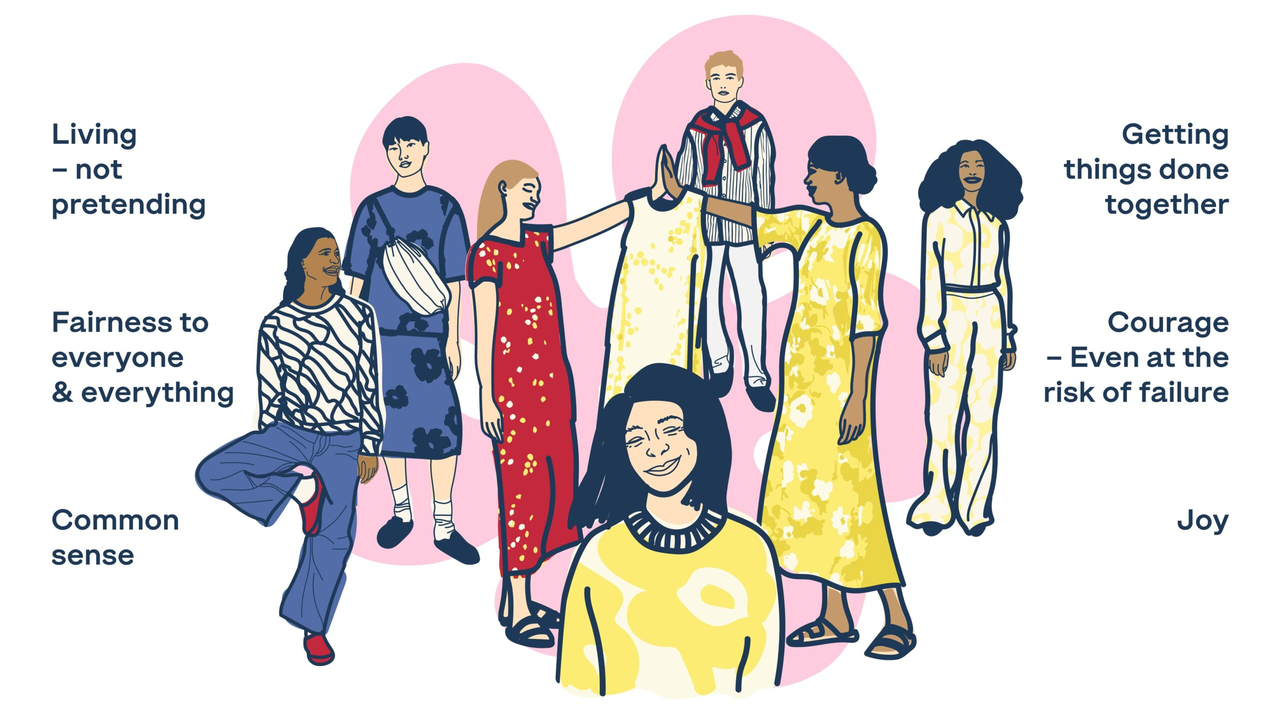 Marimekko has always sought to bring color and joy into everyday life and encourage people to feel at ease being themselves
That sense of joy carries through to Marimekko’s loose, unrestrictive silhouettes, which express the brand’s belief in freedom of movement, equality, and bold self-expression.
This gives Marimekko’s prints, product design, and core philosophy a common thread. The patterns make the brand’s outlook tangible. Consumers can see its enthusiasm for life and its belief in freedom in the prints themselves.
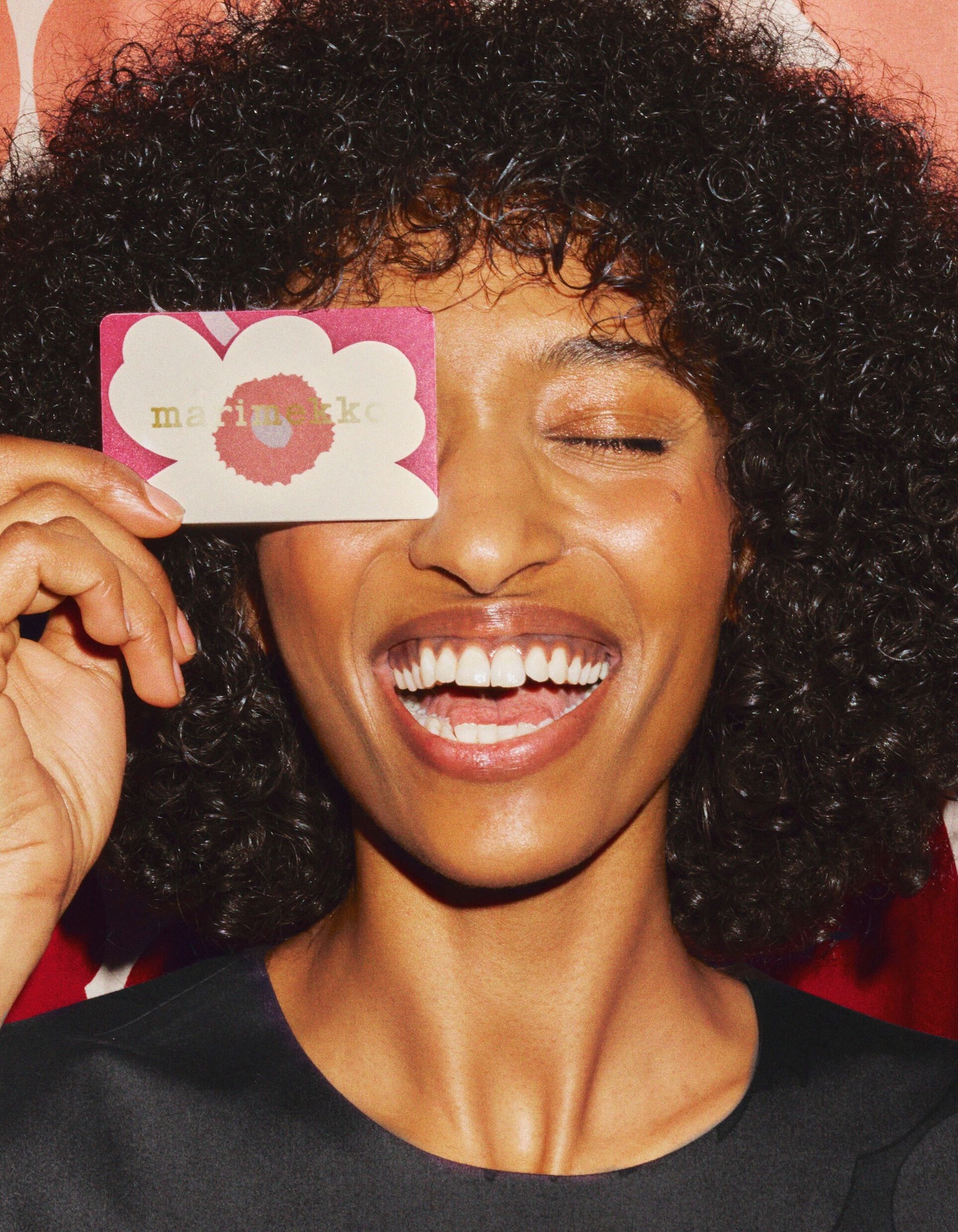
Marimekko has grown into an internationally recognized lifestyle design brand spanning apparel, home goods, accessories, and more. It has stayed true to its founding outlook. Alongside making a fashion statement, Marimekko’s designs express a positive way of life full of “JOY,” with prints as its most enduring and vivid expression.
➌ How prints trace the brand’s history
As Marimekko’s prints became brand signatures that embodied its philosophy, they also became a record of the company’s growth.
Each print dates to a particular stage in the brand’s development, whether it reflects a designer’s experimentation or a response to the aesthetics and social currents of the time. Together, the changing styles trace how Marimekko’s design thinking evolved as the company matured.
The 1968 Tasaraita print, for example, responded directly to the global push for equal rights in the 1960s. Designer Annika Rimala, an advocate of simplicity, chose evenly spaced stripes over elaborate ornamentation to convey equality and inclusion. She wanted to design a collection for everyone, regardless of age, size, or gender.

The Siirtolapuutarha print depicts a journey from the city back to the garden, expressing a love of nature, a sense of nostalgia, and the brand’s environmental outlook. It also reflects Marimekko’s evolution from an apparel brand into a lifestyle brand spanning home goods and other categories. Its home products brought in Finnish ideals of country living and simple pleasures.
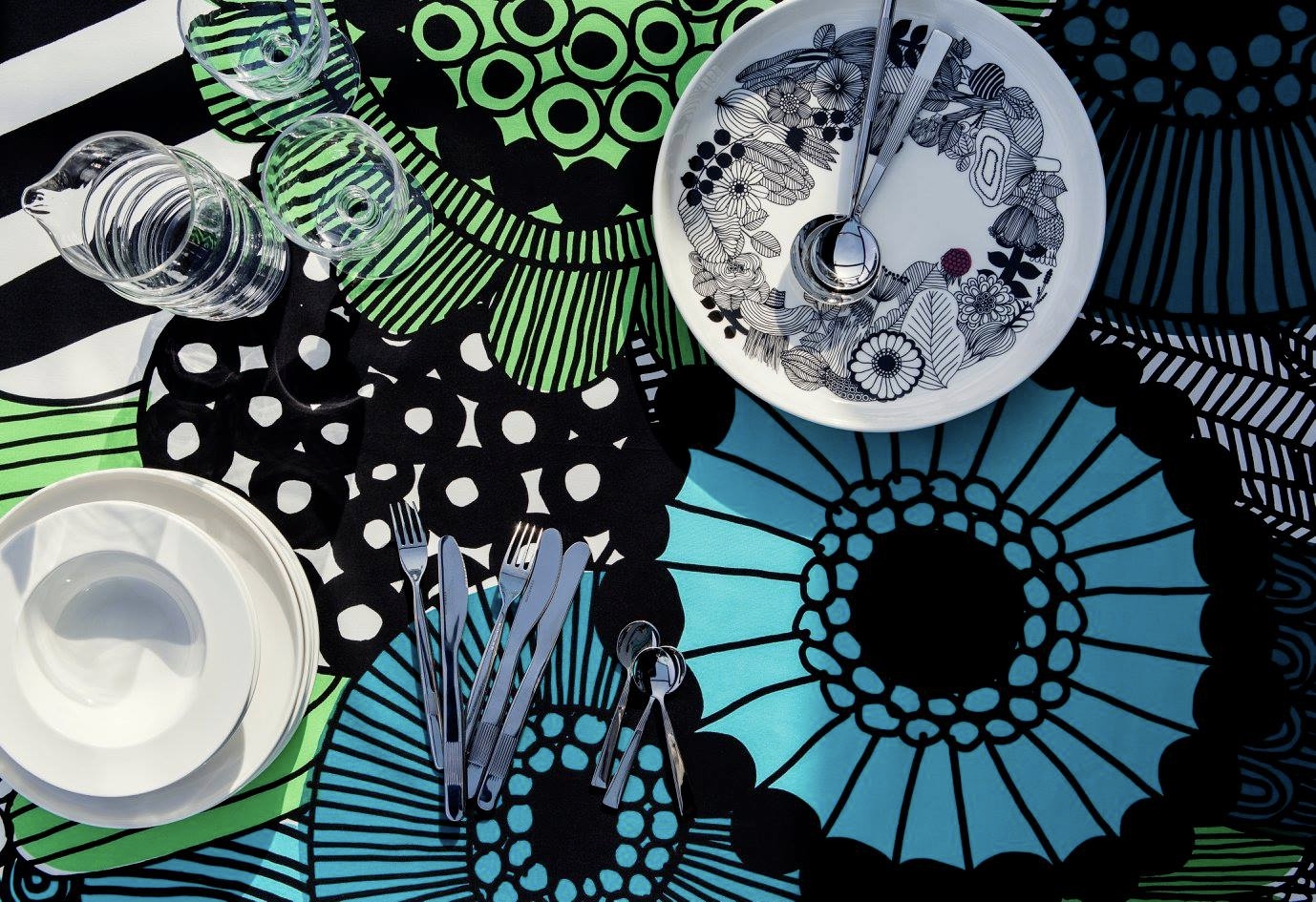
Brands with a long history often have a signature product or design that carries their collective memory.
Levi’s 501 jeans became an emblem of retro culture through their classic cut. Balenciaga’s LE City Bag became a signature piece through its motorcycle-inspired look and practical design. Converse’s All Star canvas sneakers went from performance basketball shoes to a symbol of street culture. Loewe staged an exhibition for the Puzzle bag’s 10th anniversary, using 19 collector’s editions to tell the story of how the bag and the brand have shaped each other.
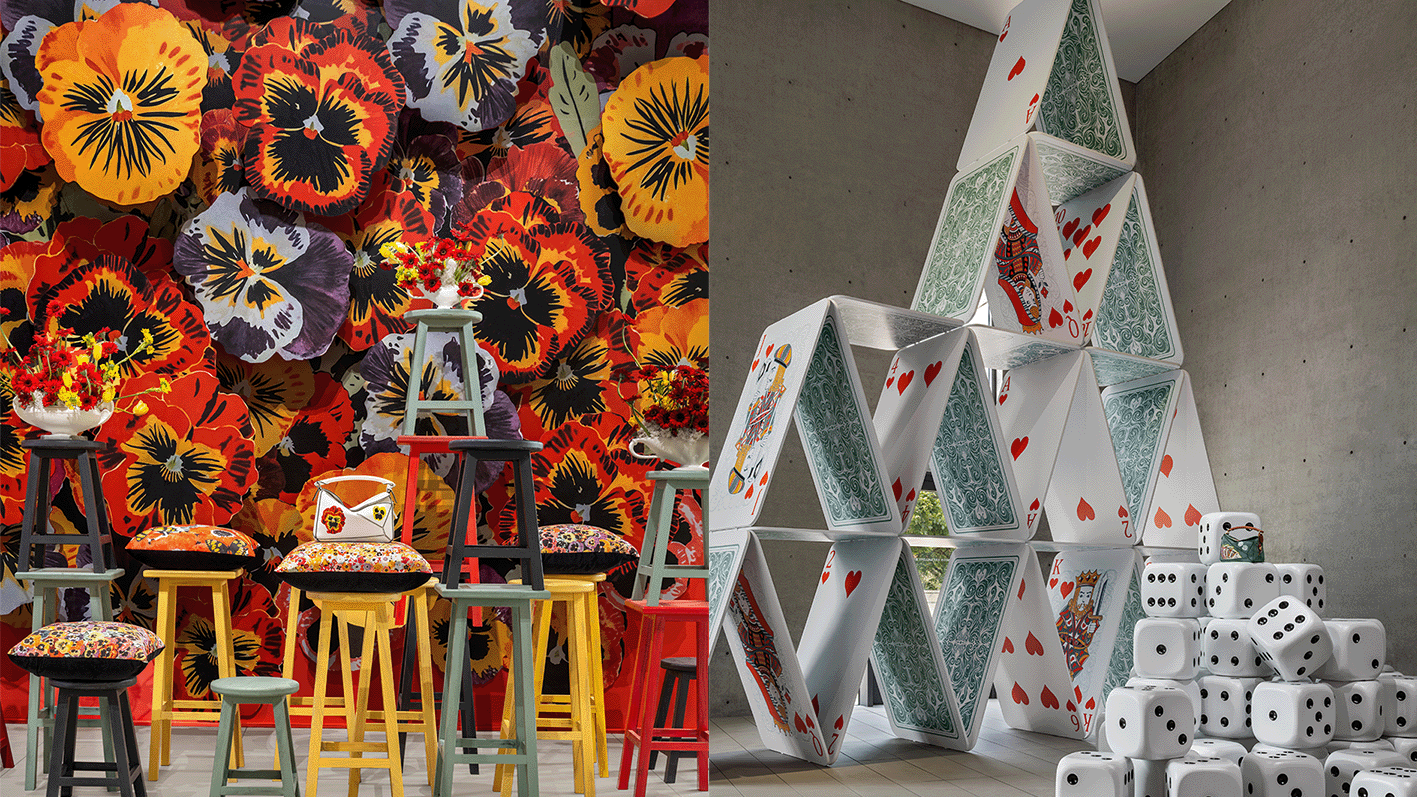 Collector’s editions of the Puzzle bag and a view of the 10th anniversary exhibition
Marimekko’s prints play a similar role. Over more than 70 years, the patterns have become part of the brand’s cultural heritage. Like Loewe’s Puzzle bag and Converse’s All Star canvas sneakers, they record key milestones and shifts in the brand’s aesthetic in their own way.
Through its prints, Marimekko keeps telling consumers a story about breaking free from convention and spreading joy, sustaining the brand’s appeal across generations.
02. Asia-Pacific strategy: Growth priorities and omnichannel expansion
The Asian touring exhibition Marimekko created for Unikko’s 60th anniversary made clear how ambitious its expansion plans were for Asia-Pacific.
As early as 2022, Marimekko launched SCALE, its long-term growth strategy for 2023–2027, identifying “Accelerate Asia growth” as a core driver.
Marimekko’s growth priorities in Asia-Pacific are Japan, mainland China, Hong Kong, Taiwan, and Southeast Asia. Japan, the brand’s second-largest market, anchors its regional strategy with an established business and strong brand recognition.

The strategy was already showing results. According to Marimekko’s third-quarter 2025 financial report, Asia-Pacific, its second-largest market, was a standout that quarter, with net sales up 8% year over year to €10.8 million. The company expected full-year 2025 net sales in the region to be flat or slightly higher than in 2024.
To reach consumers more effectively, Marimekko continues to build out its Asia-Pacific retail network through an omnichannel strategy that combines digital expansion with a stronger physical retail presence.
- Digital expansion. Marimekko is expanding its partner-led retail model. In 2024, it upgraded its digital channels in China and launched online stores in Vietnam and Malaysia, quickly filling gaps in its digital coverage across Southeast Asia.
- Physical retail expansion. The brand continues to build out its store network in key cities. It opened two stores in Japan in 2024, in Koshigaya and Sendai, followed by openings in Osaka and Kuala Lumpur in 2025 that extended its regional reach.
Marimekko planned to add 10–15 branded stores and shop-in-shops by the end of 2025, most of them in Asia, using its online and physical channels together to support further growth in Asia-Pacific.
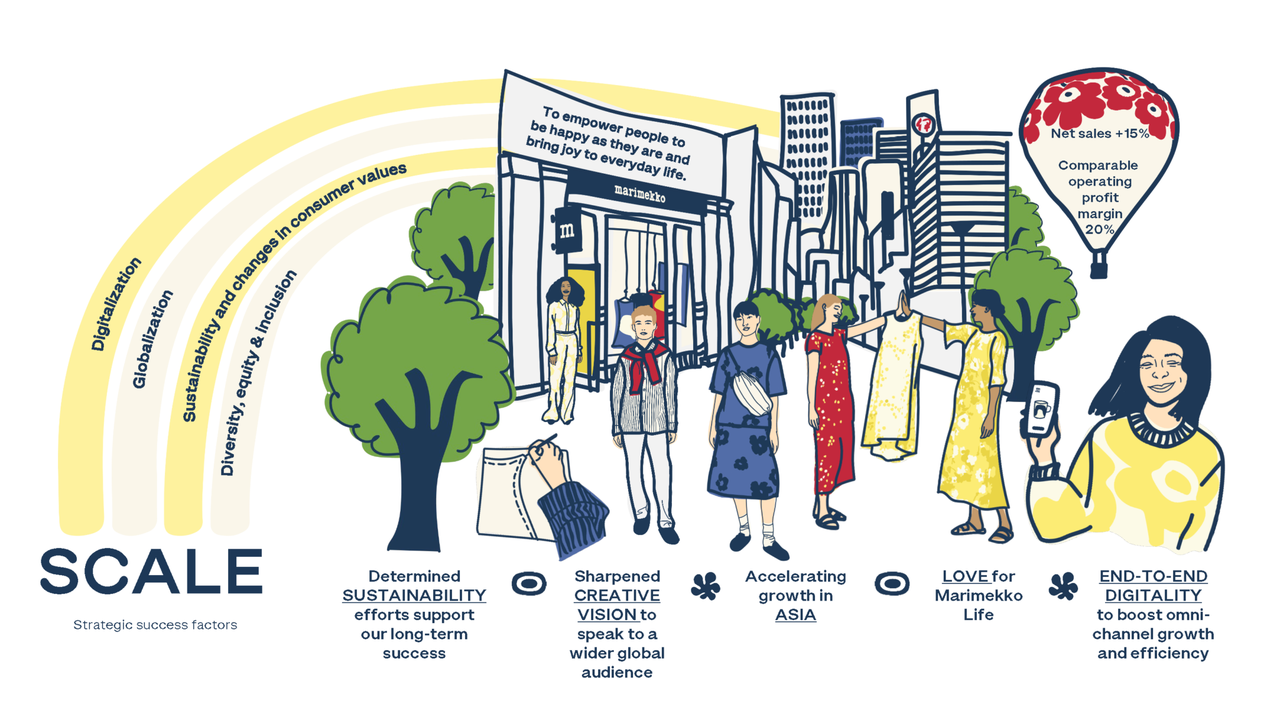
Marimekko has also directed more marketing resources toward Asia-Pacific. In 2024, it used cultural events marking Unikko’s 60th anniversary in cities including Shanghai and Hong Kong to raise the brand’s profile.
- Pop-ups in major Asian cities. In 2024, Marimekko opened the limited-time “Unikko Forever” pop-up at Shanghai’s iapm mall, which also served as one of the venues for its global touring fashion show.
- Public art on the move. In Hong Kong, Marimekko wrapped a tram in the Unikko print, turning it into a moving artwork on the city’s streets.
- Japan-exclusive marketing. Marimekko held its first open-air Marimekko Day fashion show in Japan and launched the Japan-exclusive Monthly Bag in 12 distinct Unikko print designs, each available in limited quantities, to deepen its connection with the local market.
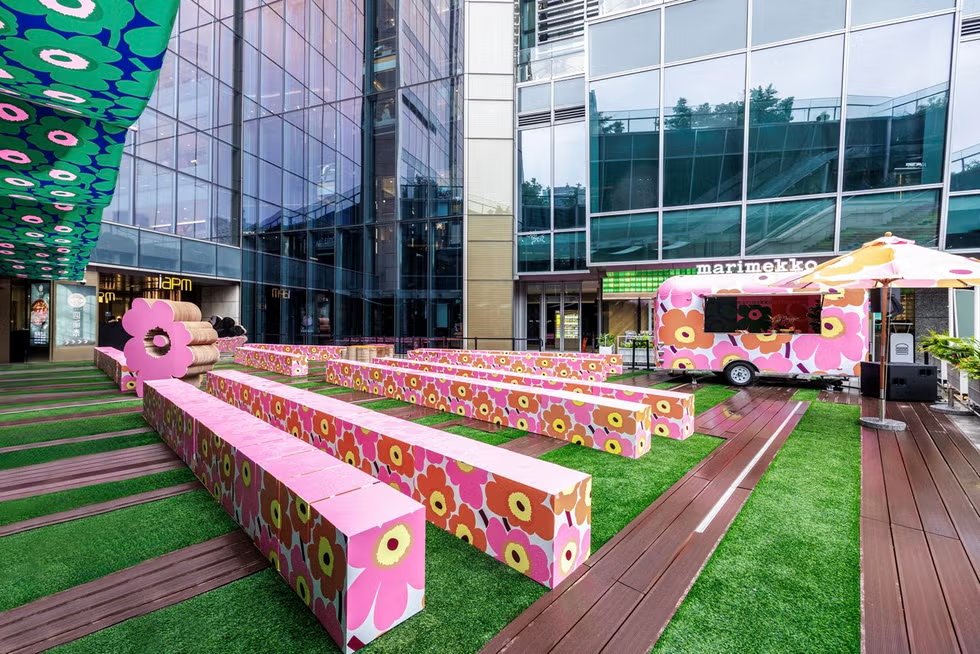
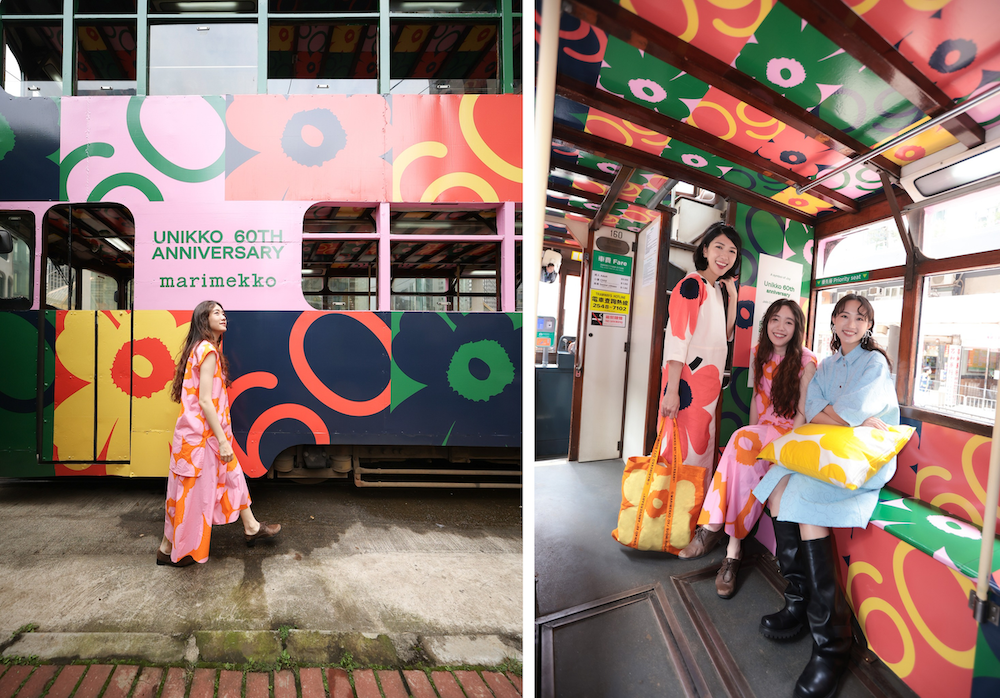 The limited-time “Unikko Forever” pop-up in Shanghai and the Unikko-wrapped tram in Hong Kong
03. Closing thoughts
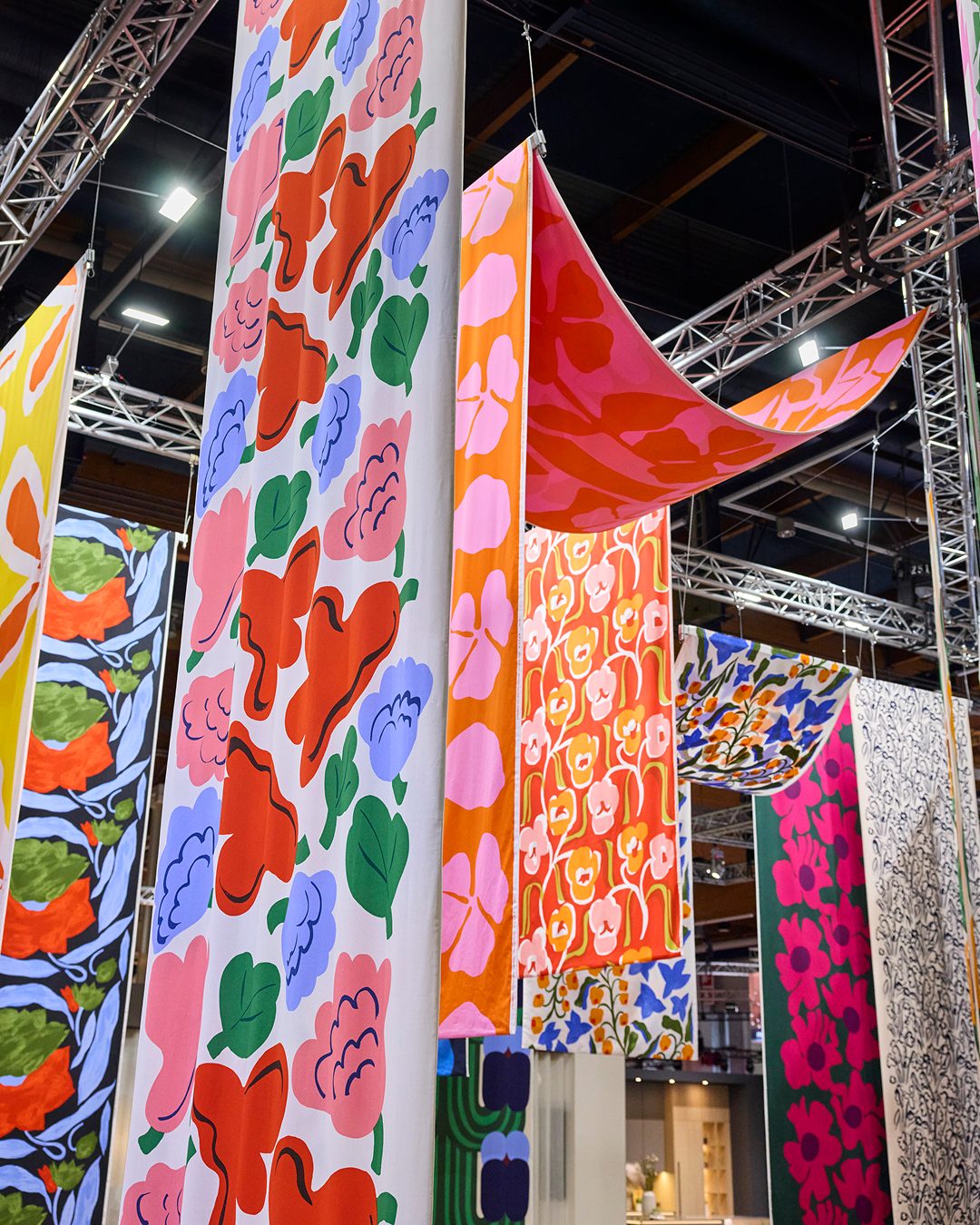
Marimekko has stayed relevant for more than 70 years by building three mutually reinforcing pillars: visual assets built around prints, brand values expressed through those prints, and commercial growth driven by them.
- First, through trademark registration and the creation of a print archive, Marimekko turned patterns such as Unikko into distinctive visual assets that competitors cannot replicate, giving the brand an enduring advantage in consumer recognition.
- Second, Marimekko embeds its values of freedom, joy, and equality in its prints and product designs. The result is a visual language with warmth and a point of view that gives those values tangible form.
- Third, Marimekko uses prints to enter new product categories and collaborate across industries, turning its visual assets and values into commercial growth and creating long-term value by bringing the brand into more parts of everyday life.
Together, these three pillars have turned Marimekko’s prints from design elements into signatures of the brand.
When consumers see that signature abstract print, it evokes a garment or a home accessory as well as an optimistic way of life that embraces each day with enthusiasm. That association helps Marimekko build a distinctive brand world that endures through changing market cycles. BRANDSTAR